
American Exceptionalism
America really is exceptional...in a way Americans may not like.

You take your job seriously. You work hard. And long. You put in the hours. (It’s always a good idea to compliment the reader.)
But how many hours per year do you work? You probably don’t know. We seldom think of work that way.
Economists do think that way, however, at least when they’re looking at the labour force in general. The number of hours worked per year by an average worker is a key statistic.
So imagine you know exactly how many hours per year you work. And answer this question: How does that compare with the hours worked per year of your grandfather? Or your great-grandfather? (Back in the day, it was mostly men in the workforce, so…)
If you know any economic history at all, you can probable sense where I’m going with this.
In general, as societies get wealthier, the average number of hours worked declines. Basically, we trade some of our gains in wealth for increased leisure. And it’s been a long time since your ancestors were in the workforce. The economy has grown. The average worker is better off. Conclusion? You probably work fewer hours per year than your grandfather. And you surely work fewer hours per year than your great-grandfather.
Right?
I started thinking about this recently when I came across the following graphic.
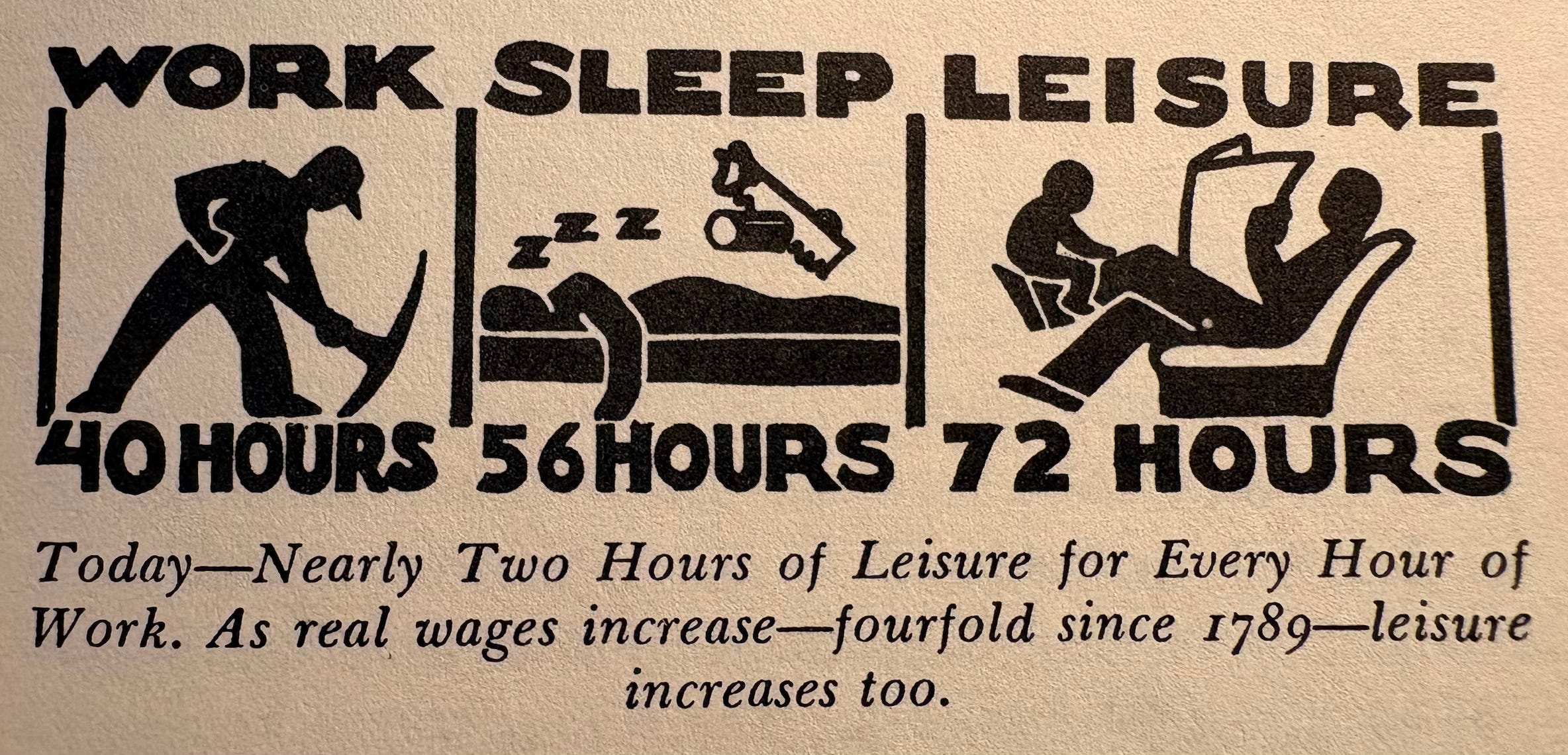
I spotted it in a book called Science for the World of Tomorrow, written by Gerald Wendt, the Director of Science for the 1939 New York World’s Fair. That’s the world’s fair whose theme was “the world of tomorrow.” It featured all sorts of exhibits about the gee-whiz world of jetpacks to come. And that’s the theme of Wendt’s book: Science produces technology; technology produces prosperity; as time and science advance, people inevitably become more prosperous. And work fewer hours.
To use a term that’s on my mind often these days — I’m writing a book about it — Wendt’s book is relentlessly in line with “technological determinism” and the ideology of inevitable progress it often supports. Technological determinism is the idea that technology drives everything. Get a certain technology and all that follows — if or how it’s used, by whom, what the consequences of that use are — comes automatically. They aren’t choices. They’re inevitable thanks to the technology itself.

In any event, Wendt’s graphic is entirely accurate.
In 1939, the American economy had been the world’s largest for half a century and Americans were the wealthiest people in the world. They had converted some of that immense bounty into leisure. As a result, the average American was wealthier than the average Briton or the average German and that average American worked fewer hours than others.
This chart tells the story.
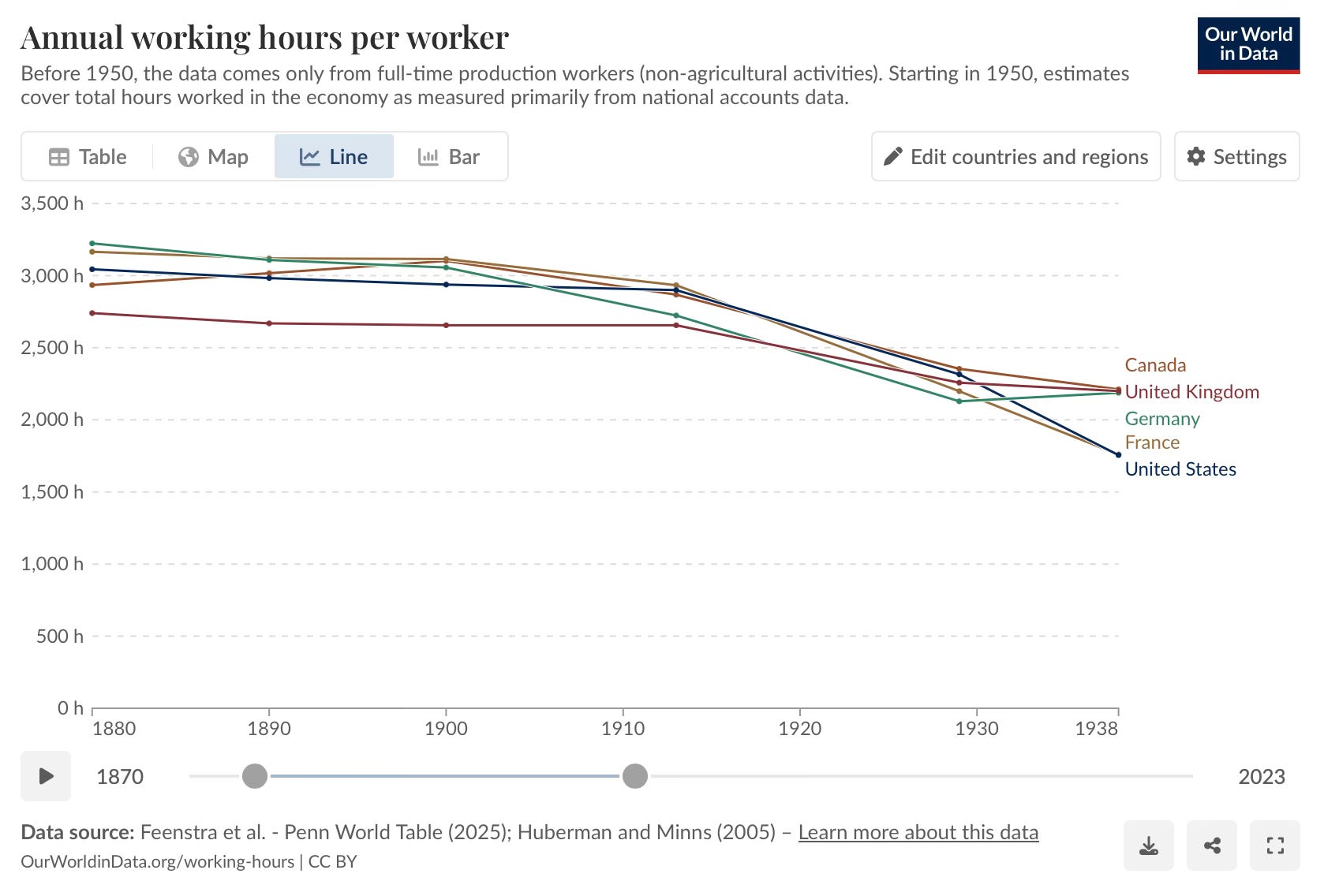
Between 1850 and 1938, all these fortunate Western countries had grown wealthier, and all had converted some of that wealth into a reduction in work hours. But the United States was wealthiest so it made perfect sense that the average American worked the fewest hours.
You may be suffering a little cognitive dissonance by now.
Today, the United States still has the world’s largest economy, the median American is still the wealthiest compared to other G7 countries, but Americans are widely known to work longer hours than workers in peer countries — while French and German workers famously (or infamously, depending on your politics) enjoy long holidays and a relaxed work week.
What gives?
Here’s the chart above extended to the present.
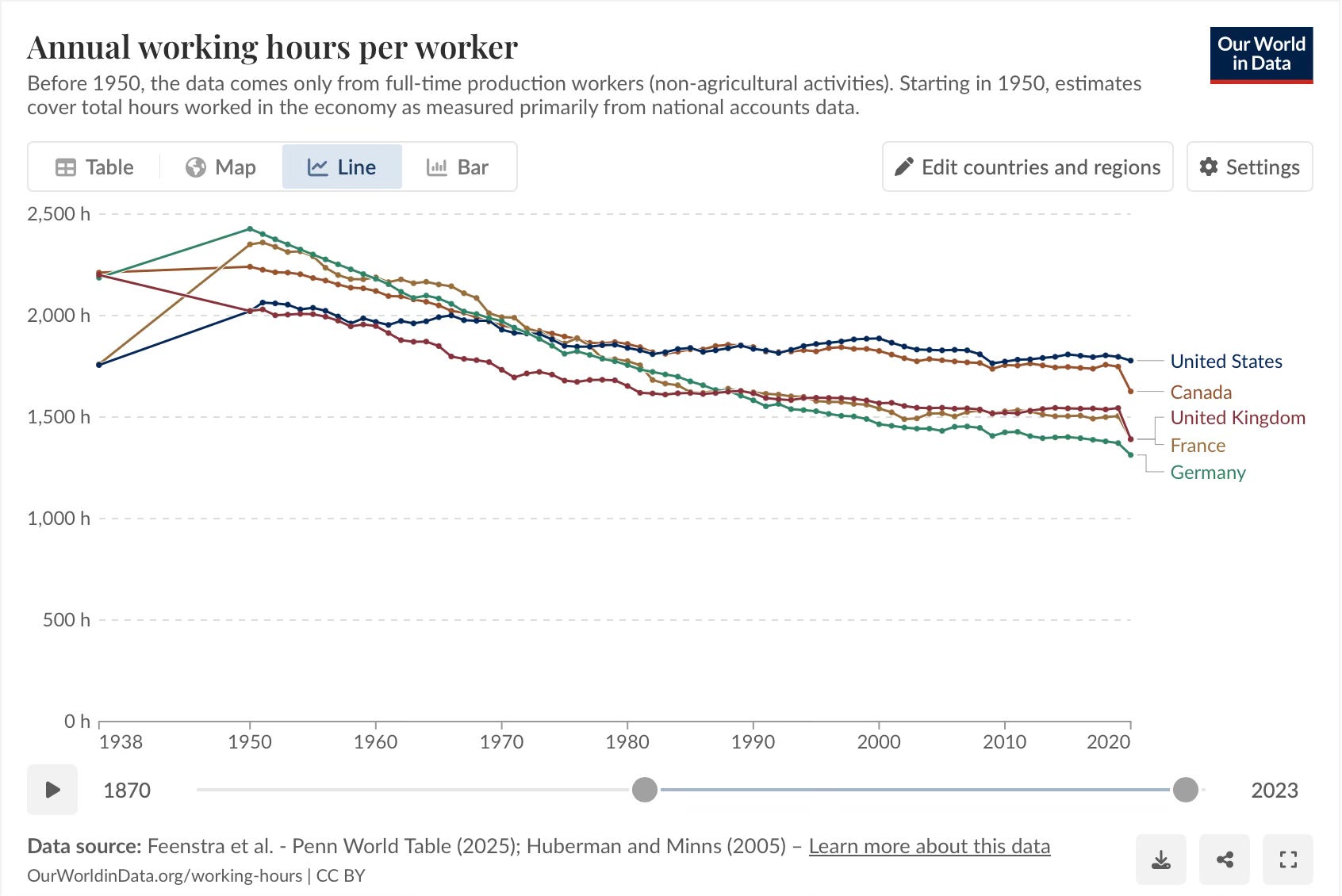
After a jump up in the 1940s — thanks to war and reconstruction — the declines resumed as wealth grew. But the American decline was less than the others until roughly 1980. Then it basically stopped, while most of the others, particularly Germany, continued to give workers more free time as income grew.
As a result, America is still the wealthiest country in the world. But Americans work longer hours than their peers.
And here’s the really crazy thing: In 1938, the average American worked 1,756 hours a year. In 2023, the average American worked 1,778 hours. So the average American works slightly longer hours today than in 1938.
And that’s despite the average American being far wealthier today: In 1938, the average American had personal income of $28,000 (in today’s, inflation-adjusted money) and household income of $38,500. Today, the equivalent figures are $48,000 and $80,610.
In other words, if you’re British or French or German, there’s a good chance you are wealthier than your grandfather and great-grandfather and you’re working shorter hours than they did. But if you’re American, you’re wealthier — and working longer hours.
If I had predicted that outcome to Gerald Wendt way back in 1938, he would have dismissed it out of hand. That’s impossible, he would have said. How could Americans get far wealthier yet work longer hours? The whole history of the United States shows that as technology advances and wealth rises, the hours worked decline!
But it happened.
Why? Because technological determinism is wrong. Advancing technology does not automatically lead to rising prosperity and fewer hours worked. Those outcomes depend on political choices.
In the distant past, the American political system chose shorter hours. In the more recent past, it didn’t.
There’s nothing inevitable about technology and its effects. People choose. Not technology. People.
The only question is, which people? And what will they choose?
With two weeks vacation , if that. Americans have little time to travel. It would be interesting to see % of Americans who have a passport. More exposure to other countries and cultures might inform political choices.
I am going to look forward to your new book!