
Bits and Bobs
MacArthur, CANZUK, prediction markets, and, sigh, Trump

Yet Another Round of Strategic Stupidity
In June, 1950, the army of Communist North Korea raced across the border, at the 38th parallel, and quickly pushed South Korean forces into a small pocket near Pusan. North Korea was on the cusp of reunifying the peninsula under the North’s Stalinist government.
With relatively few forces, and little time to prepare, US General Douglas MacArthur, the hero of America’s island-hopping strategy in the South Pacific, launched an audacious counterattack that started with an amphibious landing in dangerous conditions far behind enemy lines. It was a brilliant success, forcing the North into a pell-mell retreat back across the border at the 38th parallel. That was the Truman administration’s goal. Mission accomplished.
But MacArthur was as arrogant as he was brilliant. He was warned not to invade the North. Communist China would intervene with its huge army, he was warned. But MacArthur scoffed. They wouldn’t dare. And if they did, his air power would cut them to ribbons.
MacArthur invaded and captured the capital of Pyongyang. Still, he didn’t stop. He pushed on, almost to the Yalu River, which marks the border between North Korea and China.
The Chinese Red Army launched an immense invasion. The Americans were forced into a bloody, brutal, frozen retreat that only narrowly avoided becoming a total rout thanks to the leadership of General Matthew Ridgway.
MacArthur’s hubris turned a quick and glorious victory into a slow, grinding war of attrition that went on for three years until both sides were so exhausted they effectively drew the line where it had been at the start of the war and walked away. More than 36,000 Americans died in the Korean War. America hadn’t been defeated. But it sure hadn’t won.
In that one story, I would argue, we see modern American military history foreshadowed: Tactical excellence. Operational brilliance. Strategic stupidity.
Look at Iran now.
This was a country with a major, modern military, yet that military has barely put a scratch on the paint job of the US Air Force. In strictly military terms, American dominance is hard to exaggerate.
But the same was true in 2003, when Bradley Fighting Vehicles raced into downtown Baghdad.
It was true in the first Gulf Warn, when American and allied forces rolled up the Iraqi army.
And it was true in Vietnam, too. Yes, Vietnam. The US military didn’t lose battles in Vietnam. Even the Tet Offensive of 1968 was militarily devastating to North Vietnam and its Viet Cong allies. It was crushing to American forces not in military terms but in what it did to political support for the American war effort.
That’s the key. If war were simply a matter of execution on the battlefield, the United States military would be undefeated. But it’s not. War is, as Clausewitz famously said, politics by other means. Success is ultimately defined by the political goal of the war.
In military terms, wars are divided into three tiers: The ground level is tactical, where soldiers, sailors, and airmen fight battles; the middle tier is operational, where generals and admirals plan and execute campaigns consisting of strings of battles; the highest tier is strategic, where the nation’s leaders choose which wars to fight, and why. Strategy is defined by politics. If the political goal is achieved, a nation wins a war. If it fails, it loses, no matter how many battles it wins.
Tactically and operationally, the US military’s record is outstanding. Not perfect. But dominant over and over again. It routinely wins battles.
But strategically? Since the Second World War, the US military has suffered a string of failures, ranging from squalid draws to crushing defeats.
The sole exception was George H.W. Bush’s Gulf War. That’s telling, because what set that war apart was Bush’s humility in setting a clear, limited, relatively modest goal: to kick Iraq out of Kuwait. They did. The end. Bush the Elder — or Bush the Greater, as I prefer to call him — had been shot down and nearly drowned as a pilot in the Second World War. He understood war. In particular, he understood the folly of arrogance.
But that was the exception. In all the other wars, the US military was undone by hubris and the almost casual approach to strategy and planning that hubris leads to. MacArthur. Johnson. Bush the Lesser. And now the king of arrogance, Donald J. Trump — who seems to have genuinely believed he could bomb Iran for a few days, kill some leaders, and install a government more to his liking, as if he were changing the drapes in the Oval Office. Trump makes MacArthur look as humble as a monk.
In The New York Times, Lydia Polgreen had an interesting observation.
On darker days, I find myself turning to a more thoroughgoing narrative: that Trump is the fulfillment of what America has always been — a self-satisfied nation, granted license by its myths about providence and exceptionalism to do whatever it wants. Trump didn’t come from nowhere, after all.
No, he did not come from nowhere.
Bush the Lesser and his administration actually believed not only that they could invade and topple Saddam Hussein quickly, reasonably enough, they believed that with this simple act Iraq would somehow transform into a freer, more democratic, more prosperous country. And this wonderful example would transform the whole Middle East.
That is mind-boggling hubris. Even the British at the height of the Empire — when Britain overflowed with arrogance — would never have dreamed of such a scheme. The closest the British came was thinking they could create a small, highly educated cadre of native elites in India who would gradually advance the subcontinent toward “civilization.” But that was a project to be measured in decades and centuries. It was not something that would wrap up before the next presidential election.
Lydia Polgreen:
Is Trump a freak of history or its fulfillment, an aberration or a culmination? The answer, surely, is both. But in the course of his presidency, Trump has revealed a much older malady: America’s unshakable faith in its ability to shape the world to its liking, indifferent to what others might want and supremely confident that its plan is the right one. Beyond Trump, it’s this disfiguring mentality we Americans must face.
I don’t know to what extent that arrogance reflects “America” or merely America’s leaders. But it’s real.
Americans and their many admirers around the world have always celebrated American confidence, the legendary can-do spirit that is such a feature of American culture. And for good reason. American confidence invites risk-taking and accomplishment. American confidence is the well-spring of much that is admirable in America.
But untethered from reason and intellectual humility — the simple recognition that reality is vast and infinitely complex — confidence becomes arrogance. American arrogance has gotten an awful lot of people killed, Americans and foreigners alike.
And it has made the US military — the most powerful in the world, the most powerful in human history — the force that wins battles and loses wars.
Get the Old Band Back Together
I got a new t-shirt.
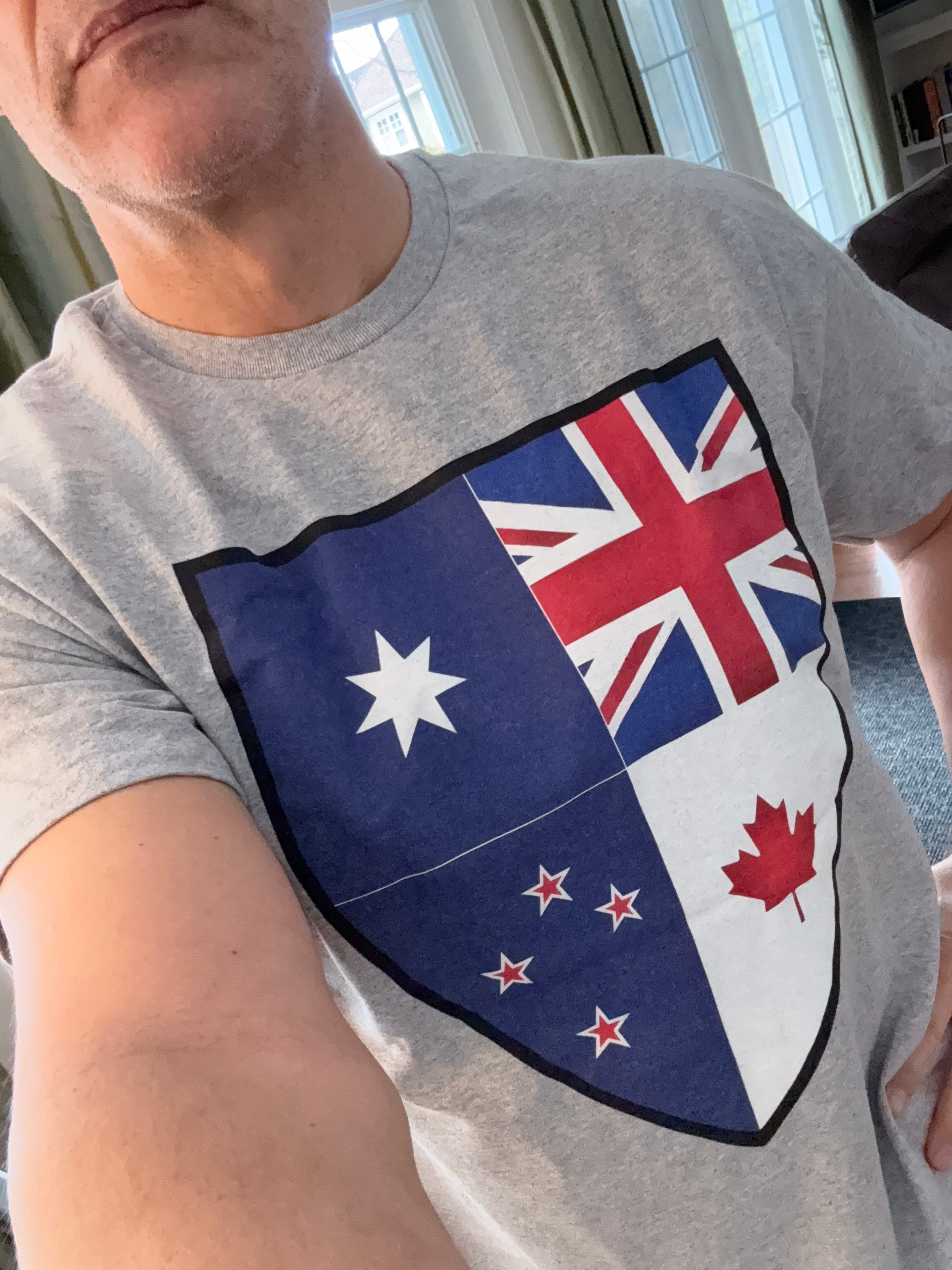
The vexillologically inclined will recognize on that shield elements taken from the flags of Britain, Canada, Australia, and New Zealand.
And what happens if you take pieces from each of those names and put them together into an acronym? You get something that is remarkably ugly, yet oddly memorable and endearing.
You get “CANZUK.”
In 1967, the New Zealand historian William David McIntyre published a book entitled Colonies Into Commonwealth in which he argued that the rise of the United States to global hegemony had unbalanced global power, leaving Britain and what were once called the Dominions of the old British Empire at a grave disadvantage. By creating a “CANZUK Union,” he argued, Britain, Canada, Australia, and New Zealand could pool resources and clout — and become a force to be reckoned with.
To a degree, McIntyre was actually reviving a much older idea known as “imperial preference,” which dated back to the late-Victorian British Empire. It called for tariffs against goods coming from outside the Empire but free trade within, and was intended to promote both economies and connections within the Empire. For decades, it got nowhere as Britain stuck to its long tradition of free trade. When the Great Depression struck, and the US and others put up tariff walls, a version of imperial preference was finally implemented. But it only lasted until the late 1940s, when the international push for broad agreement to simultaneously lower tariffs got underway.
McIntyre never got his CANZUK Union, of course, and American dominance only grew over the following half century. But over the last 15 years or so, particularly since Brexit — that world-historic own-goal — this old idea has been dusted off by growing numbers of people. There’s even a CANZUK International. And frankly, in this fracturing world, what once sounded a little eccentric increasingly makes good sense.
When Canadian Prime Minister Mark Carney visited Australia recently, he pitched a stronger partnership. Australia is a middle power whose superpower ally is looking increasingly dubious these days, Carney said. We have long history together. Shared Parliamentary and legal traditions. Similar values. Similar interests. Deep ties and institutional connections. We even have the same head of state! Let’s do this.
He could give the same speech in New Zealand. And the UK.
Put it all together and what does it spell?
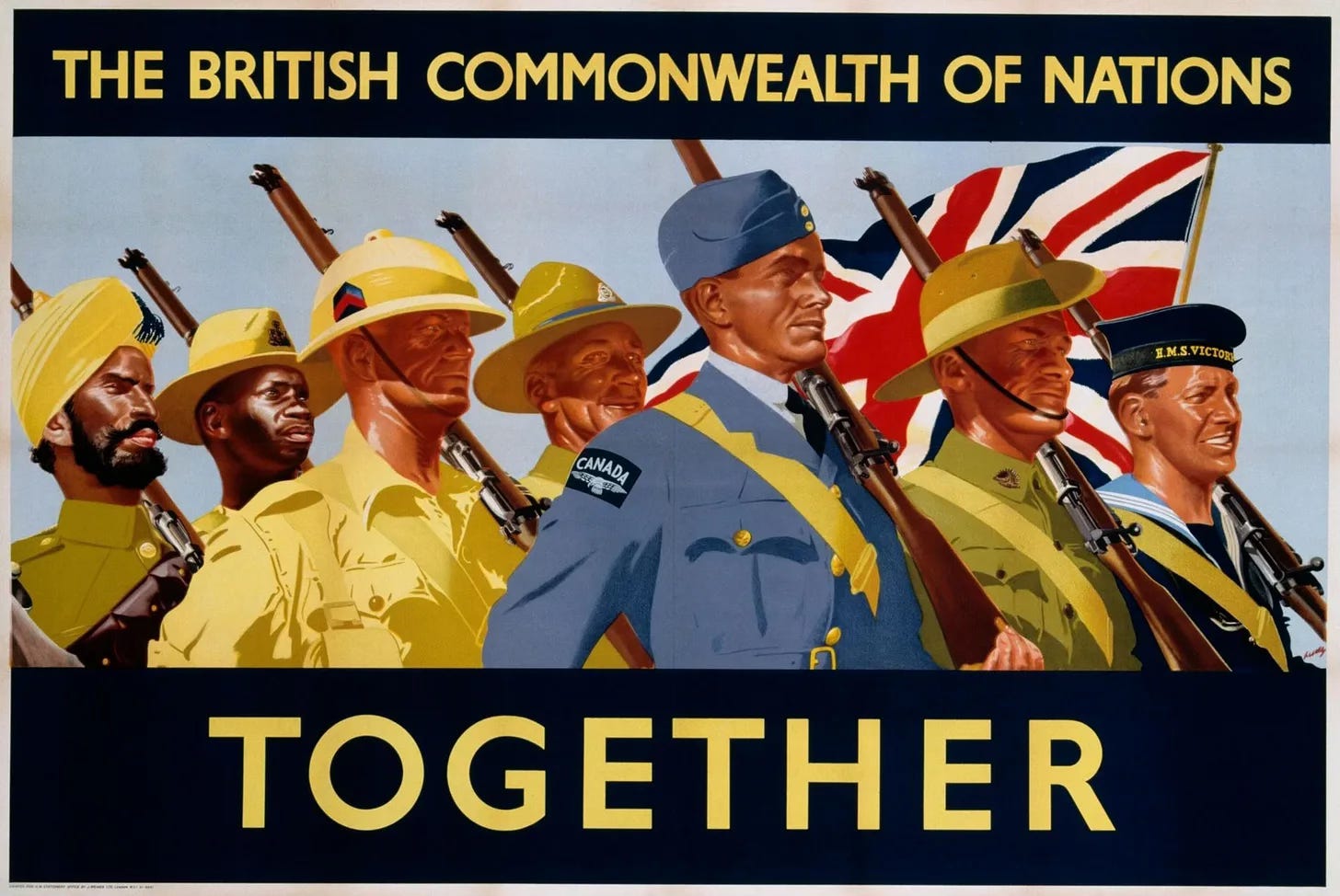
CANZUK!
The Problem of the Perfectly Predictable
As a general rule, a problem that is perfectly predictable is less of a problem. If you see it coming, after all, you deal with it before it smacks you in the face. Simple, right? So when something that is as predictable as a clock smacks faces, we know there's a deeper, underlying problem. Maybe it’s the competence of the people in charge. Maybe it’s a lack of accountability. Maybe it’s that people who should care don’t.
Whatever it is, there’s a more serious problem at work.
The latest illustration is — fittingly enough — prediction markets.
Prediction markets are decades old, and based on an idea stretching back more than a century. But today’s prediction market giants are barely two years old. Until that time, prediction markets were mainly of interest to academic researchers or organizations that created their own, internal markets.
The idea is simple: People make their best guess as to whether some event will or won’t happen and they buy and sell contracts accordingly. In this way, the judgments of all those individual people are pooled and that collective judgment is expressed in the price of the contract. More importantly, all the information those people have gathered is also pooled and expressed in the price. In this way, the market is a brilliant information aggregator, and prices tend to be considerably more accurate than the predictions of any one individual.
In that sense, prediction markets are not much different than stock markets, and they’re very similar to “futures” markets in which people trade commodities in the belief that price of the commodity in a contract will rise or fall. Call it right and you make money. Screw up and lose. Want to know what Trump’s war in the Middle East will do to the price of oil three months from now? The futures market is a good place to check.
But markets are only good information aggregators under certain conditions. More importantly, when there’s money involved, people will try to game the system. Tight regulation and strict monitoring are essential.
So before these markets took off — from $100 million a month trade volume in 2024 to $21 billion a month this year — did they ensure that all that regulation and monitoring was in place? Of course not! They mostly just let it rip. And American governments, particularly the Trump administration, looked on with bland indifference. (Of course, “indifference” assumes there weren’t backroom “contributions,” which is never a safe bet in American politics. In any event, it looked on and did nothing.)
The easiest prediction in the world was to say, in 2025, that bad things were going to happen in these lightly regulated markets.
Barely a year later, that bet is paying off handsomely.
Scandals and hints of scandals are proliferating rapidly. The most serious are the many bets that suggest people within the US military, or even the political chain of command, used insider knowledge of operations in Venezuela and Iran to make a killing. But there are lots of other troubling cases, like the Israeli journalist threatened with death by gamblers if he didn’t rewrite a story to say an Iranian missile struck the ground rather than fragments of an Iranian missile struck by an interceptor; the gamblers had put big money on whether Israel would be hit hit by a missile, not missile fragments, as reported by the media, hence their keen interest the wording of this otherwise obscure news story.
In response to a growing uproar, and rising calls for government action, the big prediction markets are rushing to tighten rules. Whether that can ever be done to a satisfactory standard on these platforms is an open question. I’m skeptical. But that’s not the question I have.
My question: Why the hell did they wait until a litany of outrages generated the threat of backlash before they started to get serious about problems that were as predictable as Big Ben?
And this is only the latest instance of executives closing the barn door after the horse has bolted and the barn has burnt to the ground. It’s not even the worst.
Last year, the parents of a teenager who killed himself sued OpenAI for failing to stop its chatbot from engaging in a months-long discussion of suicide with the boy — a discussion in which the chatbot not only convinced the boy he should not tell his parents about his suicidal thoughts, as the boy suggested, it gave the boy extremely detailed instructions on the most effective way to hang himself. After this and other cases came to light, OpenAI swiftly implemented new safeguards which would prevent something similar from happening again. And publicly congratulated itself.
To which one can only say: Why in God’s name were the safeguards not put in place before you released the product? The chatbot was marketed at teenagers! What’s the first thought that comes to mind when you think of teenagers? Moody. Depressed. And yes, in extreme cases, suicidal. If you worked for OpenAI, and you thought about the coming release of your product, could you have anticipated that teens with suicidal thoughts would discuss them with the chatbot? Of course you could. It would take 30 seconds of reflection to spot the danger. Nothing could be more predictable.
So why did it take the deaths of children for OpenAI to do something?
Is it incompetence? A lack of accountability and fear of consequences of gross mismanagement? A sociopathic lack of concern for the well-being of fellow human beings?
I don’t know the answer. But I’m sure getting sick of asking the question.
What You Reward, You Get More Of
The mindset of a hardcore Islamist who wants to wipe out unbelievers may not be the easiest to slip into and examine. But let’s give it a try.
Say you’re a senior Iranian official. You’ve been actively engaged in politics for the past quarter-century. What are you thinking these days?
You saw what the Americans did to your hated nemesis, Saddam Hussein, who pretended he possessed weapons of mass destruction (and may even have believed it) when he did not.
So you backed Iran’s nuclear program.
The goal of that program was to bring Iran close to having nuclear weapons without quite producing nuclear weapons. The last bit was key. Everyone thought the actual creation of nuclear weapons would trigger an American attack, so Iran would enrich uranium and work on ballistic missiles and the US would be deterred not by the possession of nukes but by Iran’s ability to quickly get nukes.
That mostly worked. The Americans and Europeans negotiated with Iran and an acceptable deal was struck. Iran eased back on its nuclear program. The deal worked as intended.
But then Donald Trump became president and he scrapped the deal. Why? It seems he hated it because Obama made it.
So Iran cranked up its nuclear program again — while again being careful not to get too close to the red line.
This time it didn’t work. First, the US and Israel bombed the program’s sites. Then they launched a full-spectrum war. Now much of your leadership is dead and your military is devastated.
Conclusions? Two are obvious.
First, the red line which Iran always observed — don’t get too close to producing nuclear weapons to avoid triggering an attack — did not work. It seems the only way to deter an American attack is to actually have nuclear weapons ready to fire in retaliation.
When the dust settles on this war, Iran should push straight to becoming a nuclear power as soon as possible .
Second, Iran’s military has shown that while it is no match, or even a challenge, for the US and Israeli militaries, it doesn’t have to be. Striking Gulf state neighbours hurts the economy of the whole region. And more importantly, the long-planned action of closing the Strait of Hormuz has, for the first time, been deployed — and it has worked brilliantly. The whole world is feeling the pain of Trump’s decision and Trump is clearly rattled. The man has flop sweat rolling down his face.
We know this because he actually lifted some of the crushing sanctions on Iranian oil in hopes that Iran will push its supply into the market to drive down global oil prices, and, more importantly, the price of gasoline in the US. Trump did this even though it means Iran will score an immense $14 billion windfall to spend however it wishes. With that one act alone, Iran will actually get more from closing the Strait of Hormuz than it did from agreeing to sign the Obama deal and halt its nuclear program.
(It wasn’t only Iran, of course. He did the same for Russia. But one suspects that, for Trump, handing a desperately needed lifeline to Vladimir Putin’s teetering economy is less bug than feature.)
So what’s your conclusion? Nukes are good. Get them as quickly as possible. But in the meantime, Iran has something almost as good — control of the Strait of Hormuz.
Even if Trump were to declare victory and walk away, it would be crazy for Iran to let up. Keep it closed. The mid-terms are coming in November so Iran has half a year to make Trump’s life hell. Demand huge concessions to open the strait. Squeeze him! If the terms are sweet enough, maybe agree to the old Obama deal. Nuclear programs are expensive. Closing the Strait of Hormuz is dirt cheap.
And when the current crisis passes? Invest heavily in all the capabilities that allow you to put a clamp on the world’s jugular vein.
What’s Trump going to do in response? Declare that the global reliance on oil is a severe danger to national and international security? Get behind the energy transition and a massive global push to scale up solar, wind, and nuclear? Hardly. The administration just paid a French company $1 billion to not build two offshore wind farms. Trump explicitly sold his administration to the oil companies in the last election. And Trump has a weirdly personal dislike of things electrical — remember the electric boat and the shark? — and an intensely personal hatred of wind power. With the right investments, Iran’s Hormuz non-nuclear nuclear option will be available for many years to come.
So where are we now? By standard metrics, the regime in Tehran — dead leaders, decimated military, a seething population — is the weakest it has ever been.
But the world now sees that the long-feared threat to the Strait of Hormuz is no longer theoretical. It is vividly real. By controlling one small stretch of water, the regime can even bring the mighty Americans to their knees. That’s power the regime never had.
And Iran owes it all to Donald Trump.
What an exciting time to be an Islamist fanatic.
An Update From Gardner Industries
After publishing How Big Things Get Done in 2023, and The Seven Rules of Trust in 2025, I’m now deep into the writing of a yet-to-be-titled book about the history of technology. For me personally, it’s a delight because this one is mostly straight-up history. I have often used history in my other books but this is the first in which my old love will be the centrepiece.
(How old is my love? The first book of history I read was a high school textbook. I read it when I was four. When I was eight, I read William Shirer’s Rise and Fall of the Third Reich. For a while, my parents’ favourite entertainment for visitors was to drag me out and have me read a randomly selected paragraph when visitors dropped by. Apparently, “Reichstag” sounds hilarious coming from an eight-year-old.)
But this new book is not history of interest only to those interested in history. I put the history of technology to work in service of an argument that goes like this: Technological determinism is wrong. Technology does not drive history, people do — because people, not technology, choose how, or if, new technologies will be adopted and used, and people, not technology, who decide if old technologies will continue to be used.
That may sound a little abstract and dry. Even (shudder) academic. But the book won’t be any of that for the simple reason that it addresses one of the great issues of our time, even if the term “technological determinism” is a phrase seldom heard.
Is AI or any other new technology inevitable? Do we simply have to sit down and accept whatever these technologies become? Whatever changes these new technologies make in our workplaces and societies? Must we resign ourselves to technologies, to conform, to adapt as best we can? I argue that the history of technology shows the answer is a resounding no.
People decide. The only question is which people.
It is not a coincidence that the people most loudly propagating technological determinist themes are the engineers and billionaires of Silicon Valley. If most people accept that technological determinism is true, that new technologies are inevitable, that what they will become and how they will change society is baked in from the moment of conception — that resistance is futile (as the Borg insisted) — it does not mean people will not make the key decisions. It only means that the people designing the technologies will make the decisions. And who designs the technologies? The engineers and billionaires of Silicon Valley.
And what happens if we all understand that technologies are shaped by people? That people decide? That resistance is not futile? Then, I hope and expect, people will demand a say in those decisions.
My book is ultimately a plea to take control back from Silicon Valley and make democracy the principal shaper of our technological future.
In the meantime, I continue to publish PastPresentFuture because it’s fun. And cheaper than therapy.
As you may have noticed, there are no paywalls on any of my writing here. And yet, a number of you — a number about the size of the small town I grew up in! — are paying subscribers.
My heartfelt thanks to you.
So what do you get for taking out a paid subscription, aside from a note like this now and then?
You support my work. I have several hundred books about technology stuffing my shelves now. Your paid subscriptions paid for all of them. They paid for a long list of my periodical subscriptions. They paid for access to archives. They paid for the computer I use to do all my work. And that is pretty much a full accounting of where your money goes.
Notice that what your paid subscription supports is not limited to my work. The great majority of the money I get from paid subscriptions goes to books, newspapers, and magazines, three embattled bastions of civilization. And somewhere between half and two-thirds of the books I buy are obscure old works that come from used book stores, a fourth bastion.
So your paid subscription not only supports my work, at this dark time, when the barbarians are at the gate, it strengthens civilization’s defences.
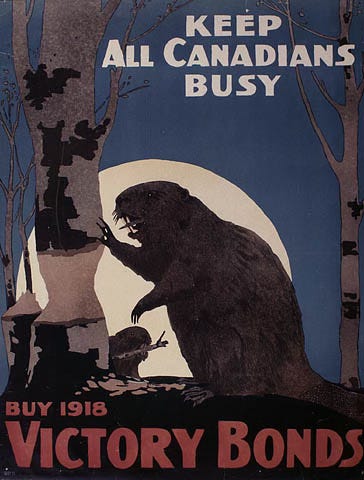
You are the good citizens who buy war bonds.
Well done, you.
A great read as always, but forced me to create myself a "CANZUK for the WIN" tee with the Canadian flag first because of-course! :-)
The other morning I pulled up petition e-6585 on ourcommons.ca. It calls for negotiations on a CANZUK pact covering labour mobility and security. That t-shirt with the four flags merged into one shield really hit the same note for me. I have seen MPs float the idea in Hansard before too. It stirs that quiet sense of shared history when bigger powers get unpredictable. This is why so many of us watch Ottawa and wonder what comes next.