
Defence Scheme No. 1
Is it back to the future for Canada and the United States?

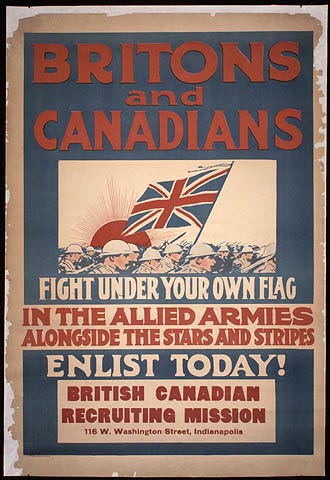
In 1917, the United States abandoned its neutrality and joined the First World War on the side of Britain and France against Germany.
That alliance did not long outlast the war. In 1921, Republican Warren Harding became president and the United States returned to isolationism. American policy would’t fully change again until Japan and Germany forced it to — first with Japan’s attack on Pearl Harbor then by Hitler’s declaration of war on the United States. When the Second World War ended, American leaders drew on the lessons of the previous half century and concluded the only way to ensure peace and prosperity was by supporting an international order grounded in law and permanent alliances.
That is elementary history, something we all should learn in high school, but it seems some Americans played hooky that day. So we saw this remarkable headline in a Canadian newspaper this week.
As a loyal dominion within the British Empire, America’s swing back to traditional isolationism — which meant no European alliances while aggressively asserting American dominance in much of the Western hemisphere — forced Canada to resume its traditional posture towards the United States. Mostly friendly. But wary.
And for good reason. As recently as the 1890s, Britain and the United States had come close to war and American officers and statesmen thought war with America’s former ally easily fell within the realm of the thinkable. In the late 1920s, American military planners completed War Plan Red, a plan for war with the British Empire whose centrepiece was the invasion of Canada — starting with the deployment of poison gas to seize Halifax.
Canadian planners were ahead of them. They had already created a defensive plan in 1921. Being good Canadians, they eschewed flashy American marketing and dubbed their plan Defence Scheme No.1.
The centrepiece of Defence Scheme No.1 was a surprise invasion of the northern United States that would see Canada seize various cities, including Seattle and Albany. Maine would also be taken. This was not a plan of conquest. The planners hoped only to shock the Americans enough to delay the inevitable American invasions, giving Britain time to send reinforcements. (The plan also called for Canada to take Minneapolis. Given the seriousness of the situation there now, I shall resist making a joke about being welcomed as liberators.)
Following is an excerpt from a memo drafted by the key Canadian officer behind the plan. The memo is dated November 11, 1927. The date is significant. For Canada, the First World War had ended only nine years earlier. On November 11.
I’ve lifted what follows below from an email circulated today by Major Jayson Geroux, an infantry officer with The Royal Canadian Regiment and a student of military history.
Five days a week, Geroux draws on his extensive collection of military histories to write up a short piece and email it. Occasionally his emails are topical, sometimes merely interesting. Some are Canadian; more are drawn from British, American, and other sources. I suggested Major Geroux should do this on Substack, but he doesn’t want to. He will, however, add some addresses to his list. If you’d like to add yours, leave an address in the comments below.
In the following memo, note that the reference to “development of the St. Lawrence” is what eventually became the St. Lawrence Seaway in the 1950s. Also note that the reference to the “Canadian Militia” means the Canadian Army; the Militia was officially renamed “Army” in November, 1940.
The United States has forced the hand of Canada on many occasions and is now attempting to force her hand with reference to the development of the St. Lawrence (seaway).
The day may come when the United States may think she is strong enough to bluff the British Empire with a threat of war. It is necessary then for the Empire to be in a strong position to meet this threat.
Canada is slowly, but surely, molding a national feeling which stands for looking after her interests and she will show a strong front to any demands from the United States. If the United States knows that the Canadian Military Forces are a factor that cannot be lightly considered and that the whole Empire is behind us they will think before they take any action against us.
This all above is not only an argument that the United States may be a possible enemy, but also to look at it from the academic point of view. A defence scheme that provides for the defence of our frontiers will cover, with but slight variations, every military problem with which we will be faced. All the great soldiers that have ever considered Canadian defence have laid that down as an axiom on which to base Canadian defence.
I think it is desirable that we should pursue the very sound course of organizing the Canadian Militia for the primary duty of Home Defence and I therefore recommend that as soon as you can get the Honourable the Minister’s concurrence Defence Scheme No. 1 should be rewritten and brought up to-date.
– Colonel J. Sutherland Brown was the Director of Military Operations and Intelligence at Army Headquarters in Ottawa, and had the duty of preparing Canadian defence plans for all eventualities. “Defence Scheme Number 1” dealt with the possibility of war between Canada and the United States, and this is an excerpt from Colonel Brown’s memo.
From “Battle Lines: Eyewitness Accounts from Canada’s Military History,” by J.L. Granatstein and Norman Hillmer.
Triggered! I did my undergrad thesis many snows ago (BA RMC 1979) on Buster Brown and inter alia spent some time analyzing Defence Scheme No. 1. In later life on the naval staff, I went on to do some modern day war plan gaming with the US Naval War College. Suffice to say that neither DS#1 nor War Plans Red / Crimson were as far-fetched as they have been made out to be, but rather were sound planning schemes. So I laud the present efforts. But when I read the headline the other day, perhaps inspired by the absolutely bizarre circumstances in which we find ourselves, I caught myself wondering if any of them might see the irony in labelling it our very own War Plan Orange?
matthewmendelsohn5@gmail.com
I'm really loving your work the past few months, Dan.