
Making 1924 Great Again
Trump's immigration policies have a familiar ring

As someone who loves to write about history in the context of current events, I suppose I should be grateful to Donald Trump. He provides an abundance of opportunities.
Trump abandons the rules based-international order? Let’s talk about 1945, the people who built that order, and why.
Trump abandons American leadership and alliances? Time for a refresher on the Republican isolationists of the 1920s.
Trump revives American imperialism in Latin America? Have a look at the 1904 “Roosevelt Corollary” to the Munroe Doctrine.
Today, I thought I might do Greenland, the Second World War, and America’s relationship with Denmark. But at the speed Trump is breaking things, that’s already yesterday’s news. So I’ll set that aside and save it for the invasion.
Instead, I thought I’d get ahead of the curve and discuss some history that hasn’t received much attention but I’m fairly confident will emerge in the public discourse in the near future.
In 1924, Congress did something that profoundly changed America for four decades. Trump isn’t doing that, exactly. As the old joke goes, “history doesn’t repeat, but it rhymes.” That's the case here.
Trump isn’t repeating 1924. But what he is doing sure seems to rhyme.
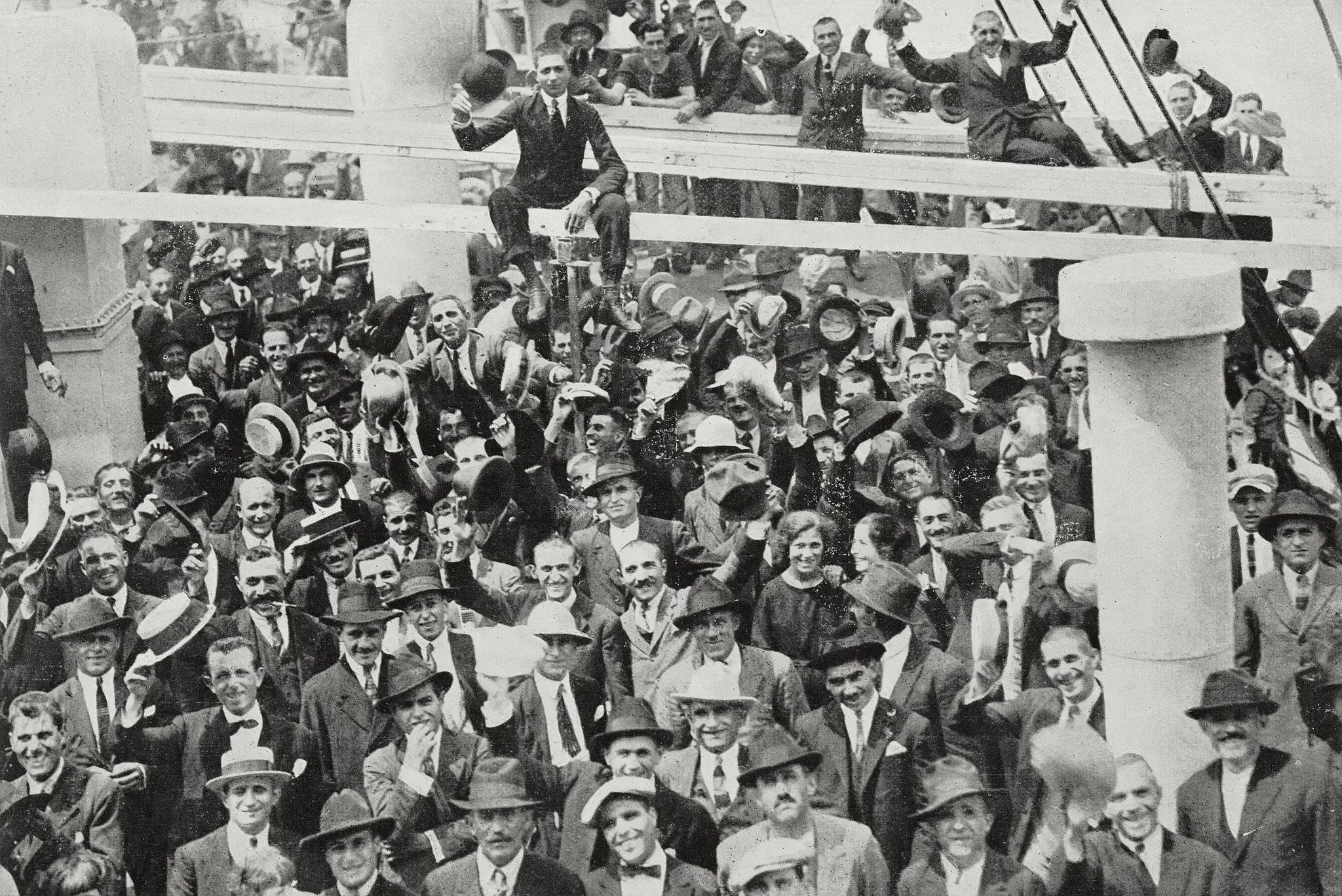
Immigrants have been coming to America as long as there has been an America, but there have only been two periods when the numbers of new arrivals topped one million or more per year.
You can see them on the chart below.
(I chose this chart because it is well-labelled, but it is old and ends in 2013. The numbers between 2013 and 2024 are as high or higher than 2013.)
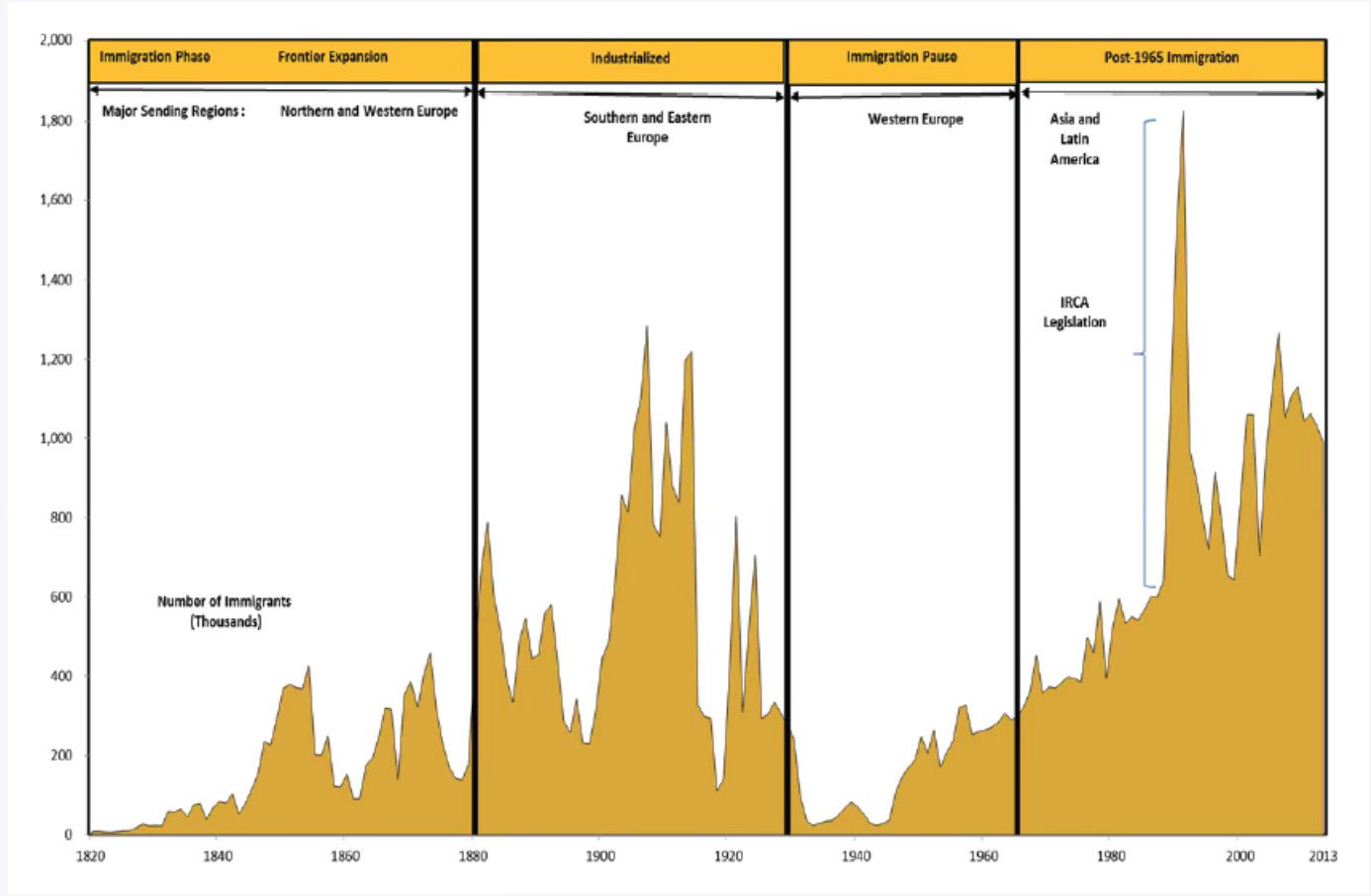
The first high-immigration era was roughly the first two decades of the 20th century; the second is roughly the last 20 years. But note these are simply total numbers of immigrants. The America of the early 20th century had less than one-third the current population — so the rate of immigration then was massively higher.
However, today’s high immigration has followed on decades with much higher numbers the what preceded the first wave. As a result, when you look at the percentage of the total population that is foreign-born, there is a remarkable similarity between the two eras.
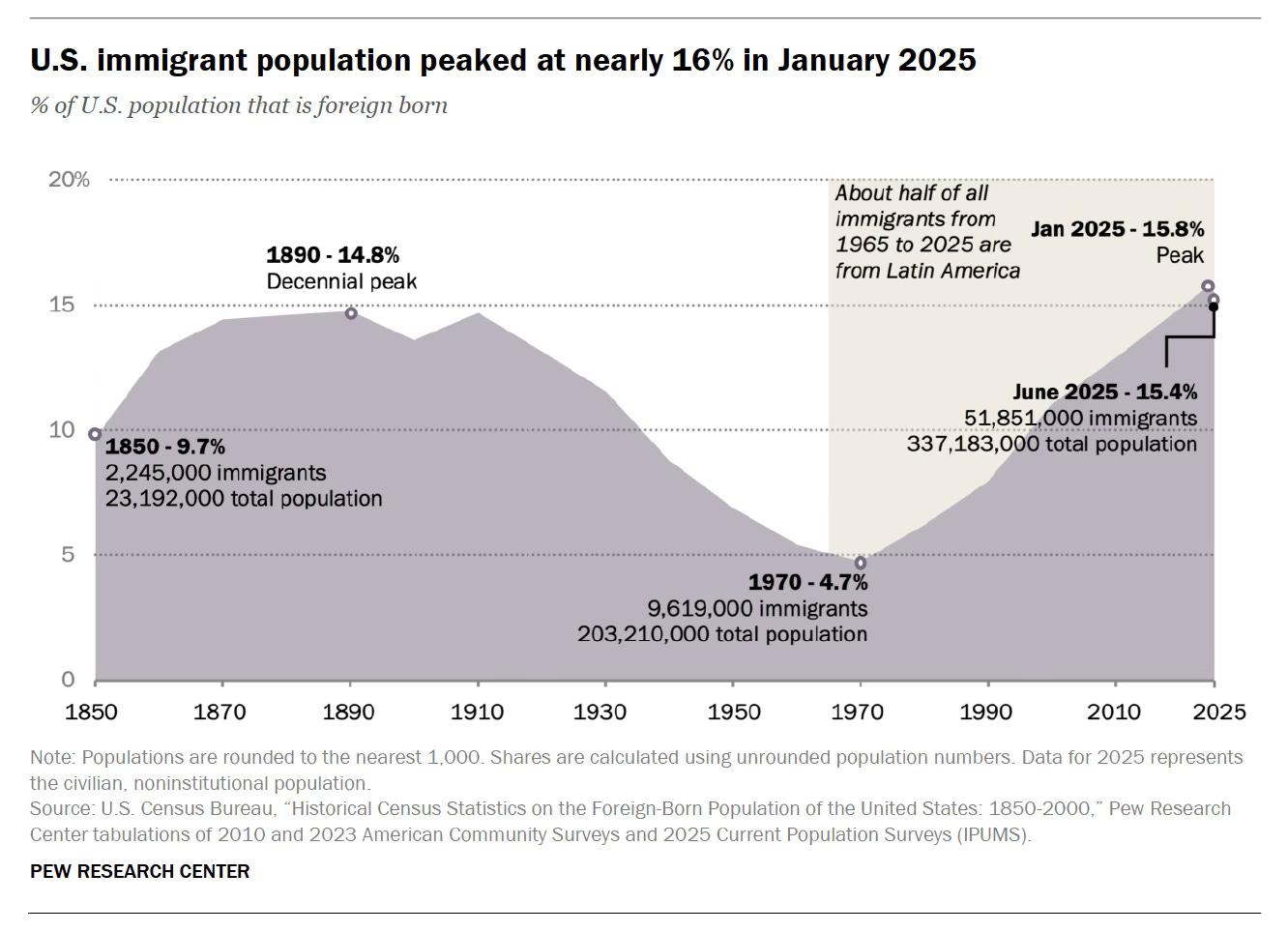
But now let’s zero in on a critical feature of that first wave — the sources of all that immigration.
From the time of the first English colonies in North America, the immigrants that came to the United States were drawn overwhelmingly from Northern and Western Europe. That changed in the late 19th century. Immigration became a story mostly of people from Eastern and Southern Europe.
That switch means little to modern Americans. Whatever Europeans may call themselves, however varied their histories and cultures, Europeans are simply “white” in the eyes of modern Americans.
But that is not how Americans of that era saw Europeans.
Immigrants from Northern and Western Europe had long come to America in large numbers and that history showed these immigrants could integrate successfully into American society and become proud Americans. But Italians, Poles, Greeks, Ukrainians, Russians, Jews? They were new. They had no history in America. As their numbers rose and immigrant ghettoes spread in the major cities, nativists feared America was importing unassimilable hordes. Look at the filthy, disease-ridden ghettoes they live in, the nativists argued. Look at the frightening levels of crime, corruption, and disorder.
They had a point. The ghettoes were squalid horrors. And this was the era when Americans first became acquainted with terms like “the Black Hand,” and “the Camorra,” the Italian organized crime gangs which flourished in the ghettoes. (The Sicilian “Mafia” wouldn’t become infamous until the 1950s.) There were even anarchist terrorists in the immigrant communities. One was Leon Czolgosz, the American-born son of Polish immigrants who murdered President William McKinley in 1901.
The rapid rise of scientific racism and eugenics amplified the worries.
A growing number of thinkers argued that America had been built by the strong, healthy, moral stock of Western and Northern Europe. Excellent stock produced an excellent nation. But these new people were fundamentally different — biologically different. They were poor and backward because they came from poor, backward countries, and those countries were poor and backward because their genetic stock was inferior.
The conclusion was obvious: If the United States allowed these people to enter in large numbers, the American population as a whole would be degraded. And America would decline.
“Import the third world, become the third world” is a saying popular among white supremacists today — it’s all over X/Twitter — but it neatly expresses a widely held view more than a century ago.
And that view wasn’t only widely held. It was socially acceptable, at least if it were expressed in coolly scientific terms. Many intellectuals of the day embraced and promoted it. They included many Progressives, who saw it not as hateful and reactionary, but as another modern, scientific, public-spirited effort by experts to implement a change for the collective good.
The most influential tract of this sort was The Passing of the Great Race by Madison Grant, an American zoologist and anthropologist. Published in 1916, the book — lifting ideas from earlier French and British writers — argued that just as the whole human population could be divided into three races (Caucasoid, Mongoloid, and Negroid) and three tiers of quality (Caucasoid on top followed by Mongoloid then Negroid), so European peoples could be sub-divided and ranked. The three European races were the Nordic, the Alpine, and the Mediterranean, in that order. The “great race” of the title is the Nordic. Grant argued that the original American immigrants had overwhelmingly come from the fit stock of the Nordics, which made America fit, but the recent changes in immigration meant America was now being filled with Alpines and Mediterraneans. Combined with the threat of miscegenation — line-crossing carnal relations — America faced nothing less than “race suicide.” The only way to avoid that fate was to halt the immigration of inferiors.
In 1917, President Theodore Roosevelt praised the book extravagantly.
Translated into German, The Passing of the Great Race earned Madison Grant many more fans. One was Adolf Hitler, who wrote Grant to tell him he considered the book his “Bible.”
That wasn’t the only tributary by which American scientific racism flowed into Naziism. In 1920, Lothrop Stoddard published The Rising Tide of Color Against White World-Supremacy. It repeated the claim that Europe’s population was divided into three, with Nordics on top. And it, too, was translated into German and developed a following. In a 1922 book, The Revolt Against Civilization: The Menace of the Under-man Stoddard linked the rise of Bolshevism to swelling numbers of the racially, mentally, and socially inferior. Translated into German, the book was a major influence on Alfred Rosenberg, the Nazi party’s top ideologue (who was hanged at Nuremberg.) In his own 1930 book, The Myth of the Twentieth Century, Rosenberg credited Stoddard for coining the term “under-man.” In German, that became “untermensch” — a core Nazi term which the regime routinely cited in support of its worst policies, particularly those of extermination.
The sky-high immigration numbers of the first-wave era hit an all-time peak in 1914 but then were driven down by the outbreak of the First World War in Europe. In 1921, they started to soar again. An emergency quota was passed to cap the increase.
America was in no mood to admit millions more newcomers: The international order had collapsed; the Spanish flu ravaged the population; the country endured a brutal economic recession; paranoia about Bolsheviks and anarchists reached new heights with the Palmer Raids in 1919 and the horrific Wall Street bombing of 1920. The membership of the reborn Ku Klux Klan exploded into the millions.
In an atmosphere of fear and anger, America turned inward first by adopting an isolationist foreign policy, then, in 1924, by telling the huddled masses that Lady Liberty would no longer welcome them.
After hearing testimony from Madison Grant, among others, Congress passed the Immigration Act of 1924. Sponsored by Representative Albert Johnson — a eugenicist — and Senator David Reed, the aim of the legislation was to halt “a stream of alien blood.” The legislation was complicated, with a temporary system brought into force in 1924 and a permanent system set to start in 1927. But the gist of the policy was simple: It capped immigration at a dramatically reduced level; it effectively banned immigration from Asia; and in the competition to get the remaining immigration slots, it strongly favoured immigrants from Western and Northern Europe over those from other regions, including Eastern and Southern Europe. (Latin America was exempted because the United States needed its agricultural workers. If that seems surprisingly pragmatic for avowed racists, remember that even the Nazis would bend racial ideology to suit political needs, most notably by bestowing “Honorary Aryan” status on those of inferior ancestry who were nonetheless useful to the Nazis.)
The whole racist machinery wasn’t repealed until 1965. “This system violates the basic principle of American democracy—the principle that values and rewards each man on the basis of his merit,” President Lyndon Johnson said, arguing for repeal. “It has been un-American in the highest sense, because it has been untrue to the faith that brought thousands to these shores even before we were a country.” The current immigration system basically dates from 1965.
Which brings me to today.
Some things are quite different about the present. Most notably, there’s little scientific racism in the air and appeals to white supremacy remain so highly stigmatized in the American culture at large, as they have been for generations, that pollsters don’t even ask Americans if they support race- and ethnicity-based immigration. But those themes are not extinct. Far from it. At a minimum, we can say some old, familiar sounds are increasingly being heard, and they are growing louder, particularly on social media.
But at a time when the President of the United States has aggregated unprecedented power in the White House — “I run the country and the world,” Trump said, and he seems to believe it — the intellectual climate may be less important than the thinking of one man. That man has expressed clear preferences about immigrants. They don’t repeat the past. But there’s an unmistakable rhyme.
In 2018, Trump reportedly said in an Oval Office meeting with lawmakers that he was sick of immigrants from “shithole countries” in Africa and elsewhere. The White House fiercely denied Trump had said that. But it was widely reported and the remark became infamous. Less well known is that Trump also suggested which countries he would welcome immigrants from.
From a Washington Post article:
“Why are we having all these people from shithole countries come here?” Trump said, according to these people, referring to countries mentioned by the lawmakers.
Trump then suggested that the United States should instead bring more people from countries such as Norway, whose prime minister he met with Wednesday. The president, according to a White House official, also suggested he would be open to more immigrants from Asian countries because he felt that they help the United States economically.
In April, 2024, when Trump was the presumptive Republican nominee for president, he spoke to a well-heeled audience in Palm Beach. The “shithole” comment that the White House insisted Donald Trump hadn’t said? Donald Trump confirmed he said it.
From The New York Times:
He then appeared to refer to an episode during his presidency when he drew significant criticism after an Oval Office meeting with federal lawmakers about immigration during which he described Haiti and some nations in Africa as “shithole countries,” compared with places like Norway.
“And when I said, you know, Why can’t we allow people to come in from nice countries, I’m trying to be nice,” Mr. Trump said at the dinner, to chuckles from the crowd. “Nice countries, you know like Denmark, Switzerland? Do we have any people coming in from Denmark? How about Switzerland? How about Norway?”
He continued, “And you know, they took that as a very terrible comment, but I felt it was fine.”
In a public speech last month, Trump again confirmed his “shithole” comment. And he again paired that with a comment about the sort of immigration he prefers:
Trump: I’ve also announced a permanent pause on Third World migration, including from hellholes like Afghanistan, Haiti, Somalia and many other countries.
Audience member: Shithole.
Trump: I didn’t say shithole, you did. [Laughter.] Remember, I said that to the senators. They came in, the Democrats. They wanted to be bipartisan. So, they came in, and they said this is totally off the record. Nothing mentioned here. We wanted to be honest, because our country was going to hell, and we had a meeting and I say, “why is it we only take people from shithole countries,” right? Why can’t we have some people from Norway, Sweden — just a few — let us have a few, from Denmark. Do you mind sending us a few people? Send us some nice people, do you mind? But we always take people from Somalia, places that are a disaster, right? Filthy, dirty, disgusting, ridden with crime.
It doesn’t take a statistician to spot the pattern. “Import the third world, become the third world” seems to be something of an axiom for Trump. And his preference for Nordic immigrants could not be any clearer.
But has this translated into policy?
On refugee policy, Trump immediately lowered the maximum total allowed to be admitted from 125,000 to 7,500 and indefinitely suspended the program, with some exceptions possible. Not long after, Trump publicly encouraged white South Africans — and only white South Africans — to seek refugee status in the United States and attacked the president of South Africa on their behalf. He promised them expedited processing. The administration has even flown them from South Africa to the United States.
As for immigration proper, the Trump administration announced on Wednesday that it will stop processing immigration visas from 75 countries. The administration says it is doing this because nationals from these countries are likely to need public assistance while living in the United States — and thus “extract wealth from the American people” — although all such applications require proof the individual wouldn’t be a public charge.
This is on top of the suspension of all visa processing — even tourist visas — from almost 40 countries. Only rare exceptions are permitted.
Here is a map of the affected countries.
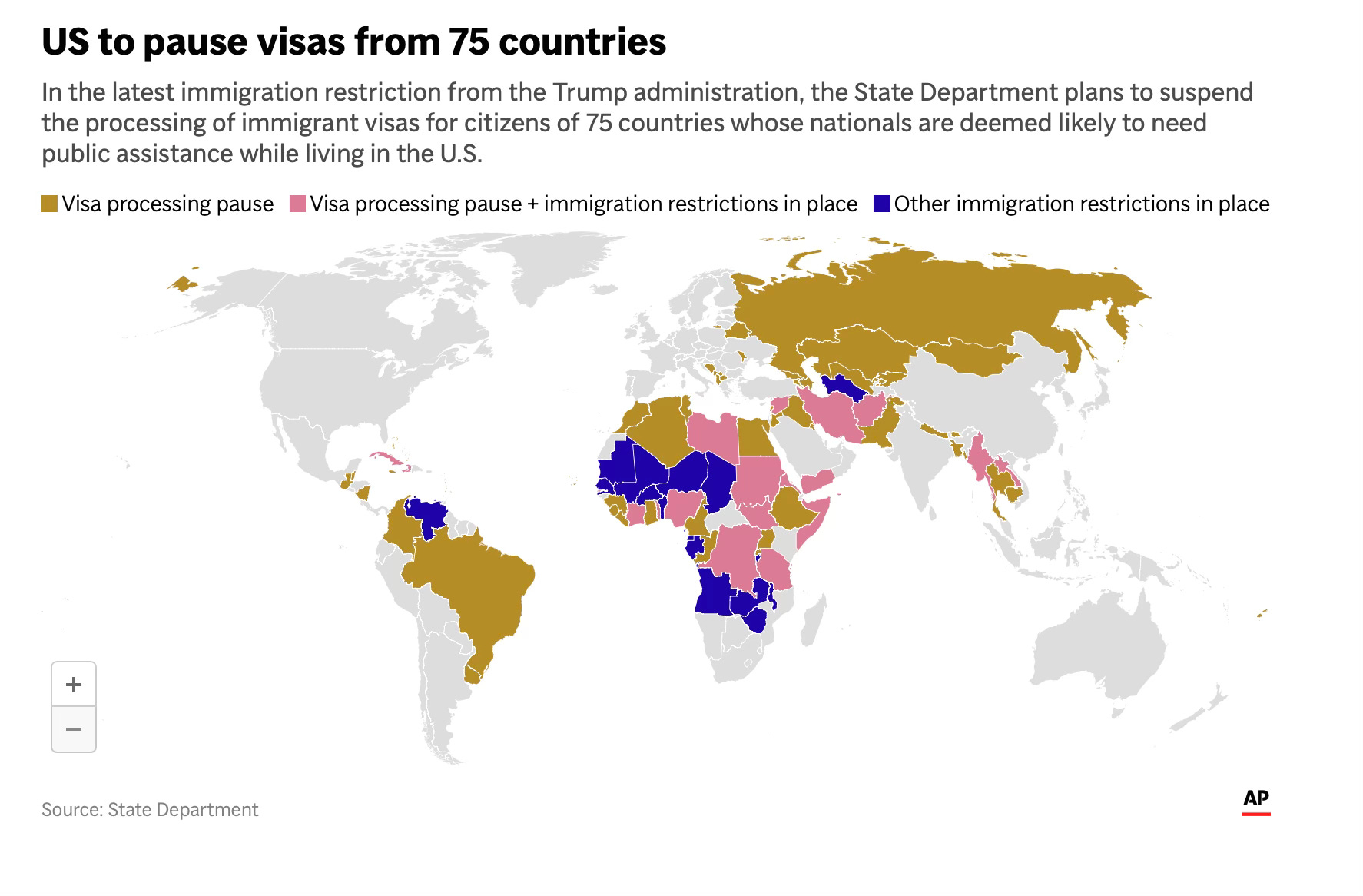
Again, I don’t think it’s a struggle to see a pattern.
There is, however, one glaring difference between what we’re seeing now and what happened in 1924. The Johnson-Reed Act was passed by Congress in heavily lopsided votes reflecting broad and deep public support for restricting immigration by race and ethnicity.
Trump has acted entirely by executive fiat. And most Americans today are not the nativists Donald Trump is. In fact, various measures of support for immigration are high and rising, or even at record levels.
If Trump wants American immigration policy to go back to 1924 for longer than he’s in office, he has his work cut out for him.
Sidebar: On the first chart, you may wonder what caused that brief but enormous spike in the numbers at the end of the 1980s and beginning of the 1990s.
That was Ronald Reagan’s doing.
The patron saint of the Republican Party was appalled by the growing numbers of illegal immigrants. But he didn’t order mass deportations. In fact, deportations were unusually low during the Reagan presidency. Instead, Reagan got the Immigration Reform and Control Act passed. Among other things, it gave an amnesty to longtime-resident illegal immigrants so they could get green cards, then citizenship. That’s the spike on the graph.
Ronald Reagan may have been a Republican like Donald Trump, but in important ways he was a Republican utterly unlike Donald Trump.
As someone who's been around *that* long: it's amazing to me to see Reagan (whom I despised at the time) looking like an enlightened progressive, by comparison.
Excellent. However, one big contrast between the US of the 1920s and Trump2 was attitudes to war and international violence. The Kellogg-Briand pact renounced the use of war to settle disputes or conflicts of whatever nature. "The settlement or solution of all disputes....shall never by sought except by pacific means" Kellogg was the US Sec of State. The Senate voted 85-1 to ratify the treaty.