
Queen Victoria's Day
On this most Canadian of days, a history of some Canadian symbols.

In (most) of Canada, today is Victoria Day.
Named in honour of Queen Victoria, the holiday was originally fixed to May 24th, Victoria’s birthday. The date was much later set on the Monday closest to the 24th, to ensure Canadians would have a spring long weekend they could celebrate the traditional ways — shivering in tents, drinking beer, and blowing off fingertips with fireworks.
The beer and whatnot will be familiar to most Canadians. The history will not be, as Canada has another long tradition of not teaching history, and a somewhat more recent tradition of actively erasing anything that smacks of the British, which is most Canadian history. Hence, the holiday is more commonly known as “May 2-4” — a nod to a case of beer, which contains 24 bottles — or simply the May long weekend.
Which is a shame, I think. Because as much as “Victoria Day” may call to mind Edward Elgar and the Raj, Victoria Day is, in fact, a uniquely Canadian holiday which has been celebrated in this country since 1845. That’s almost a quarter-century before modern Canada was founded in 1867, easily making Victoria Day one of Canada’s oldest traditions. I’d go so far as to say that Victoria Day is as Canadian as hockey but the first organized game of hockey was played on March 3, 1875 — so it would be more accurate to say hockey is as Canadian as Queen Victoria. (The location of that first hockey game? The “Victoria Skating Rink” in Montreal. QED.)
All of that is by way of introduction.
A number of years ago, I wrote a short essay about Canadian symbols and history riffing on a very old portrait of Queen Victoria that hangs in my cottage.
It follows below.
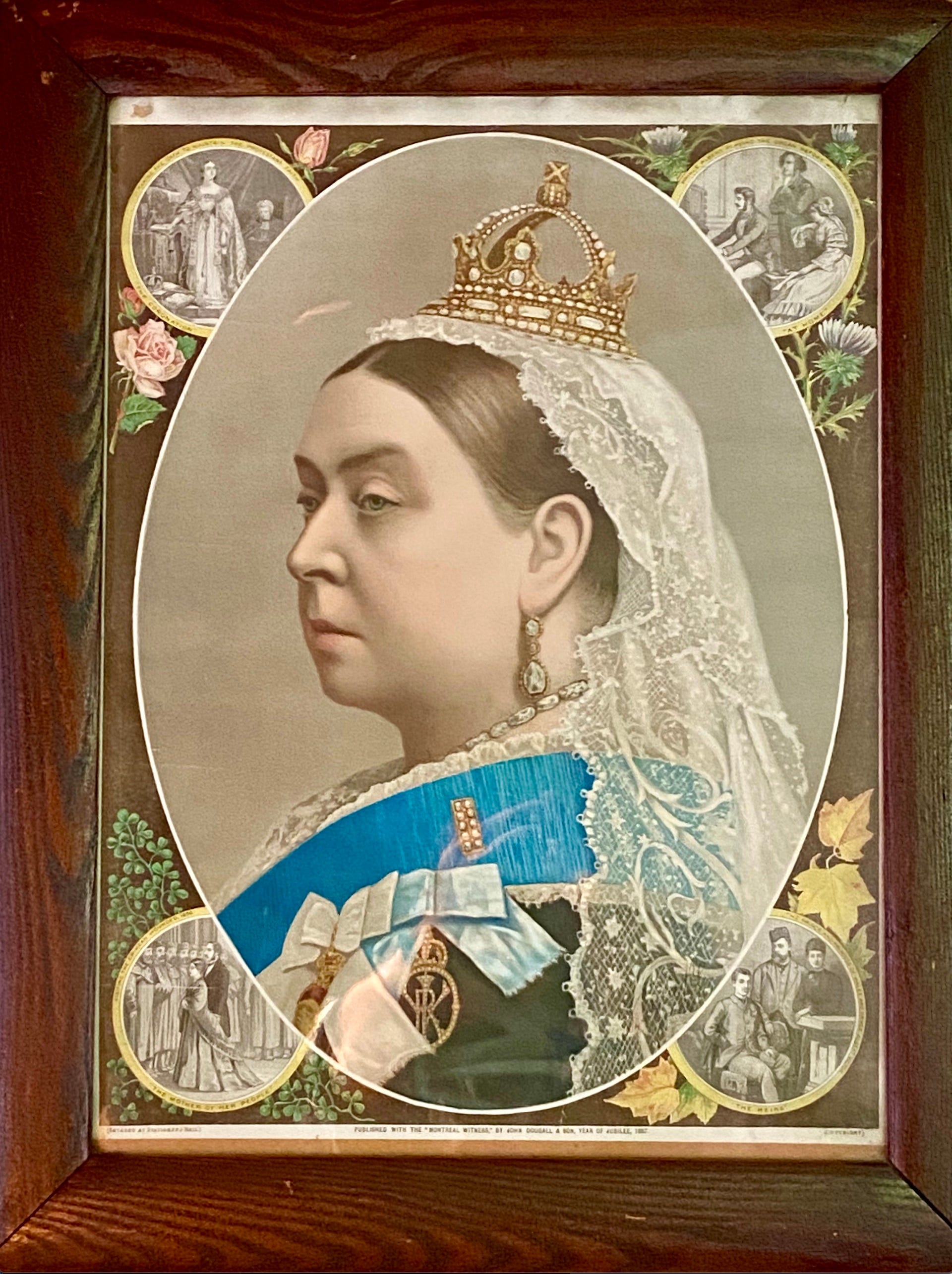
The portrait above is, of course, a portrait of Queen Victoria. It hangs on my cottage wall, along with portraits of Laurier, Gladstone, Kennedy, Franklin Roosevelt, King Edward, and sundry long-dead notables. (Someone once commented that the room appears to have been decorated by Agatha Christie. That is entirely accurate.)
I discovered Her Majesty’s dark and glowering presence at a junk shop in Westport, Ontario. The owner told me she got the portrait at an estate sale in Westmount, the old Montreal Anglo neighbourhood. A thick layer of soot clung to the glass so I can only assume it hung in a smoke-filled room for generations. After some vigorous cleaning, Her Majesty still glowered, but brightly.
Perhaps this old monarch presided over a parlour in which Montreal notables drank sherry and grumbled about the latest news from the Boer War. A nice image. A little history. But is that all there is? Let’s take a closer look.
First, the maker and the occasion, printed at the bottom: “PUBLISHED WITH THE MONTREAL WITNESS, BY JOHN DOUGALL & SON, YEAR OF JUBILEE, 1887.”
The Montreal Witness was an influential Protestant newspaper published in English. John Dougall founded it in 1845 and it continued publishing until 1938. Not surprisingly, given the time, it was anti-Catholic. When a former priest started writing for the newspaper, the Catholic Church formally forbade Catholics from reading it. (“The past is a foreign country,” the British novelist L. P. Hartley famously observed. “They do things differently there.” For a modern Canadian, there’s no better reminder of that than the bewildering role of religion in 19th century Canada.)
Now, think about this portrait again. It was a newspaper insert. And look at the frame. It’s modest. Did it really hang in the parlour of some wealthy Montreal merchant? Possibly, but let’s not allow Westmount stereotypes to cloud our judgement. The modest many far outnumbered the rich few. It’s more likely that someone of limited means clipped it from the newspaper, framed it, and hung it on the ordinary wall of an ordinary home. This was common practice. I’ve seen portraits of monarchs hung in frames made of boards split by hand with an axe. Newspapers weren’t propagandizing when they printed images of monarchs. Or rather, they weren’t only propagandizing. They were satisfying popular demand.
As for the “Year of Jubilee,” that’s the Golden Jubilee of 1887, half a century since Victoria became Queen in 1837. For Canadians in 1887, Victoria’s reign was already a watershed.
In 1867, Queen Victoria had signed Canada into existence and made Ottawa its capital. As the first dominion, Canada became a model of development – colonies becoming semi-independent countries within the empire – that would be followed in Australia and elsewhere. But much more than politics had changed.
When Victoria took the throne in 1837, slavery had only recently been abolished. Rail was almost non-existent in Canada. Information still moved at the speed of a horse. In many ways, the world was much as it had been in the 18th century and the centuries before. But by 1887, trains, steamships, telegraphs, photographs, and mass-circulation newspapers had connected the vast, isolated distances in Canada, and connected Canada with Britain, the Empire, and the world. It was a transformation more profound than the introduction of the personal computer and the Internet. And with electrification, it was accelerating.
To most Canadians, this era of dizzying growth and change was embodied in Queen Victoria. It was hard to recall life before her. By 1887, Victoria’s birthday – May 24th – has already been an official holiday in Canada for 42 years.
We can be sure that this was far from the only one of John Dougall’s newspaper inserts to be clipped and framed.
So let’s take a look at the details of the portrait.
Notice that there are small scenes in the four corners. The top left is the Queen being crowned and “taking the oath to defend the Protestant faith.” (John Dougall was clearly not fond of subtlety.) Top right is Prince Albert, Victoria’s beloved but quite dead husband, playing the organ for Felix Mendelssohn, the great composer. Bottom left is Victoria visiting the wounded of the Crimean War, 1856. Bottom right is the Prince of Wales and son, “the heirs.”
So it’s mostly British royal history. Not much that’s specifically Canadian, you may think.
But notice also that the scenes are decorated with foliage. In one, it’s roses. In another, it’s thistles. A third is shamrocks. The fourth is maple leaves. That’s some obvious symbolism, right? The English rose, the Scottish thistle, the Irish shamrock, and the Canadian maple leaf.
But that’s wrong. A clue that it’s wrong can be found on the modern flag of Montreal, which is a red cross on a white background with a rose, a thistle, a shamrock, and a fleur-de-lis (plus a white pine in the centre, added in 2017). That’s an English rose, a Scottish thistle, an Irish shamrock, a French fleur-de-lis (the white pine represents indigenous peoples). These are quite literal symbols of ethnicity for the city of Montreal.
But if that’s the case, the maple leaf on the 1887 portrait looks out of place. To us, it’s a national symbol, not tied to any ethnicity, yet here, logically, it should stand for the French in Montreal. But if it’s supposed to mean that, why wasn’t a fleur-de-lis used?
This is where the history gets obscure. And fun, if you are so inclined, as I am. Let’s go through the history of each symbol:
The rose came to prominence in the Middle Ages as a symbol of Mary, mother of Jesus. Much later, it was used in various places by noble houses – think Game of Thrones – including those of Lancaster and York, who fought “the War of the Roses” for control of the throne. Their roses were symbolically fused in the Tudor rose to mark unity. But most of that story is bullshit. The use of the symbols was post-facto exaggerated for purposes of later political propaganda, and the “War of the Roses” was a romantic moniker invented centuries later. But never mind. The rose became an important symbol in English heraldry, boosted further when Queen Elizabeth, the virgin Queen, used the symbol because she wanted to make the connection with Mary. (Symbols are always propaganda, in the literal sense.)
The Scottish thistle again emerges from layers of often self-serving myth. The standard story is that the King of Norway, who held mainland territory in Scotland, invaded with the intent of taking more. One force crept forward in the night to launch a sneak attack, so, to be as quiet as possible, they removed their footwear. One man stepped on a thistle, yelped, and Scotland was saved. Great story. Probably bullshit. But a great story.
As for the Irish shamrock, legend has it that when St. Patrick was converting the heathens in Ireland he used shamrocks to illustrate the Trinity. The shamrock was thus a religious symbol for many centuries. Only in the late 18th century was it first used for secular purposes when – this is so Irish – rival militias appropriated it.
Notably, none of these symbols was used as a truly national symbol, meaning symbols representing a sovereign people. That’s largely because the idea of “a people” is mostly a 19th century invention, and only then does it become common to use these symbols to mean “the English” or “the Irish.”
(Another notable theme: Everyone ignores the Welsh. The original floral symbol of Wales is a leek. That may explain why.)
So when Montreal created its first coat of arms, in 1833, it came up with something that looks a lot like today’s flag: A red cross with the rose, thistle, and shamrock to refer specifically to the English, Scottish, and Irish populations of Montreal. And the fourth symbol, for the French? Not the fleur-de-lis. A beaver.
This made historical sense, for obvious reasons, but you can imagine John Dougall preparing his portrait of Queen Victoria and thinking, “three plants and a rodent? Seriously?” He doesn’t want to spoil his portrait with a wet rat. But he’s got to have a symbol for the French in Montreal. And it has to be like the other symbols – a plant of some kind.
So why didn’t he use the fleur-de-lis? Why the maple leaf?
The fleur-de-lis is ancient, appearing in many different cultures, ranging from what is today’s southern Russian to India, but in the Middle Ages, it was commonly used by French kings. It symbolized power, not people, and it evolved into a symbol of the state. This explains why a common form of punishment – of criminals and escaped slaves – was to be branded with a fleur-de-lis.
When the French Revolution swept out the French monarchy in 1789, the fleur-de-lis was aggressively erased in much the same way that the Bolsheviks would erase Czarist symbols after taking power in Russia. As French nationalism rose, the idea of the French people, and French-ness, was expressed with the symbols of the revolution, not the fleur-de-lis, whose use faded.
The history was subtly different in Quebec. When New France came under new management in 1759, the fleur-de-lis fell into disuse but it was not actively erased and suppressed, so it could still be found on church bells and whatnot.
When a symbol for les Canadiens was needed, as in Montreal’s coat of arms, it was the beaver. Or a maple leaf. In fact, the original symbol of the St. Jean Baptiste Society, founded in 1834, was the maple leaf.
That’s what John Dougall meant by using the maple leaf in that portrait of Queen Victoria. It’s not a symbol of Canada. It’s a symbol of les Canadiens. But Dougall was being a little old-fashioned in using it that way. By 1887, the maple leaf was well on its way to evolving from a symbol of the French people of Quebec to a symbol of Canada and Canadians of all ethnic backgrounds.
That transition was helped along by another that occurred simultaneously: In North America, the fleur-de-lis was revived as a symbol not of state power but of all things French. Montreal’s arms and flag were changed to replace the beaver with the fleur-de-lis in 1938 and 1939. The flag of Quebec, so similar to the old flag of royalist France with its prominent fleur-des-lis, was adopted in 1948.
When Queen Victoria died in 1901, her birthday continued to be marked as a holiday in a country that had changed profoundly during her lifetime. When Queen Elizabeth (born April 21, 1926) took the throne in 1953, Victoria Day became the day when the reigning monarch’s birth would be officially celebrated -- an admirably frugal arrangement.
But Victoria Day remains Victoria Day. To nationalists of a certain vintage, a holiday named after the long-dead monarch of a long-gone Empire is an embarrassing reminder of the British Canada they grew up in. Pierre Berton, for one, wanted to turn Victoria Day into something eye-rolling like “Heritage Day.”
A more recent and resonant objection is that Victoria Day is colonialist and should be replaced or erased as part of indigenous reconciliation. There’s a story in the Globe today with someone making that case. Of course, the holiday’s roots in colonial history are hard to argue. This is Queen Victoria, after all. But it’s noteworthy that the person making this argument also objects to Canada Day on the same grounds. He has a point. Canada Day – like Canada itself – comes from the same colonial history.
Victoria Day is older than Canada Day by a century and a half, and older than the Dominion Day that Canada Day replaced by a quarter of a century. It’s older than the national anthem, the trans-continental railway, the Stanley and Grey Cups, and Confederation itself. It’s almost a century-and-a-quarter older than the red-and-white maple leaf flag that seems to be the only national symbol left that hasn’t faded, or become a dead letter, or come under fire for its connections to those parts of history everyone wishes had never happened.
But I suspect the flag’s time is coming. After all, it bears Canada’s official colours, chosen in 1921, at the peak of imperial bluster and racism, and the maple leaf was found on the flags at residential schools and the badges of the soldiers who fought Louis Riel. Like Canada Day, the flag is bound up in all the same history as Victoria Day, so if those who object to Victoria Day and Canada Day also object to the flag, they can’t be faulted for inconsistency – unlike those who would jettison one but not the others.
Of course the history of symbols is a history of evolution, as I hope is clear by now. But the line between evolution and erasure is fuzzy and easily crossed. And when there are profound political divides underlying the symbols, neither evolution nor erasure is likely to bring people together. When French revolutionaries hunted down and destroyed fleurs-des-lis and replaced them with new symbols, they only created the appearance of unity. And even that didn’t last.
For politicians faced with the existential imperative of reconciliation, and the immense complexity and political challenge that goes with it, symbols are easy. Get rid of this. Alter that. They’re among the few changes they clearly have the power to make and are, by their very nature, highly visible. That’s tempting.
But when there are cracks in the wall, changing the portrait of the person that hangs on the wall will do nothing to stop the cracks from growing. There really is no alternative to fixing the structure itself.
The part of the fleur de lis history that Dan Garner does not mention is why this symbol of old France (and New France) made a come back both in France and then in Quebec, at the end of the 19th century. That happened because of the debate over how France would be politically organized, after the defeat of 1870 by the Prussians, the loss of Alsace-Lorraine and the fall of Napoleon III. The choice was between three regimes: A republic (the one that would eventually become France's 3rd Republic, when the other two options proved unworkable), a constitutional monarchy or an absolute monarchy. The latter two choices depended on the assent of the last surviving male descendant of the French royal family, Henri comte de Chambord (who would have reigned as Henry V, had he accepted what the post-1870 French parliament was willing to grant him). The French parliament wanted him to reign as king of the French (that is: as a constitutional monarch). Henri de Chambord only wanted to reign as an absolute monarch (that is: as king of France). The point was who did the king represent: the general will of the French or some abstract idea of France which he alone, as king, represented. Thus the fight between two flags: The fleur de lys of absolute monarchy, or the blue-white and red flag of the 1789 revolution (which was originally a symbol of constitutional monarchy, and which only became the symbol of a republic because Louis XVI betrayed the Revolution by fleeing to Varennes, a few years after having accepted it). Henri de Chambord indicated that he would only accept kingship under a fleurdelis flag (that is: that he would only accept to reign as an absolute monarch, not as a constitutional monarch). That ended the monarchy in France and the third republic was created instead. The fleur de lis then became the symbol of the reactionary ultraright in France, those who had lost their chance to go back to pre 1789 France in 1873.
One of the ardent defender of absolute monarchy, in France, was one Général de Charette, who was also the leader of the Zouaves volunteers who had come to defend the pope against the revolutionaries of Italy. It is through the Zouaves movement being led by Général de Charette that the fleurdelis made a come back to Quebec. And the purpose of adopting a fleurdelisé flag was not to give French Canada a flag it did not possess. It was to replace the blue-white-and-red flag that both Canada and Acadia had adopted since the days when Brits and French allied during the Crimean war (as a symbol of having buried the war hatchet of the Hundred years war to become allies again). Acadia put a star on that flag not to distinguish herself from France, but to distinguish herself from that other snobbish and main province of New France, Canada (New France had three provinces: Acadia, Canada and Louisiana).
Quebec liberals strongly opposed the introduction of the fleurdelis until the 1960s. The only reason they accepted it in the end is that Lesage needed the vote of the more militant faction of Quebec nationalism, to get elected and pass the educational reforms he and his fellow liberals wanted so much (that's why they fought the 1962 election on the nationalist and antisemitic slogan MAÎTRE CHEZ NOUS and on Quebec Hydro --not because that was a controversial issue, but because it was NOT controversial and allowed Lesage to buy time for the really controversial political change he was implementing, and which needed more time).
This was a fascinating read!!! Thank you.