
The Hundred Years' War
A brief history of the futile and destructive war on drugs.

Let’s start with some ancient history that has already been well and thoroughly forgotten: Mexican security forces cornered and killed the cartel leader Nemesio Oseguera Cervantes, better known as “El Mencho.” The foot soldiers of El Mencho’s private army, the Jalisco New Generation Cartel, responded by going on a rampage, torching cars and businesses and terrorizing ordinary Mexicans.
That was a little more than two weeks ago. In the United States, Canada, and elsewhere, it was major news. For about two days. And the turmoil in Mexico really wasn’t itself the focus of the news. No, the really big news that drew all the foreign reporters was that the turmoil had shut down airports and disrupted the travel of tourists.
Stranded tourists — that was big news.
When the airports reopened and flights resumed, the reporters went home.
Story over. On to the next thing.
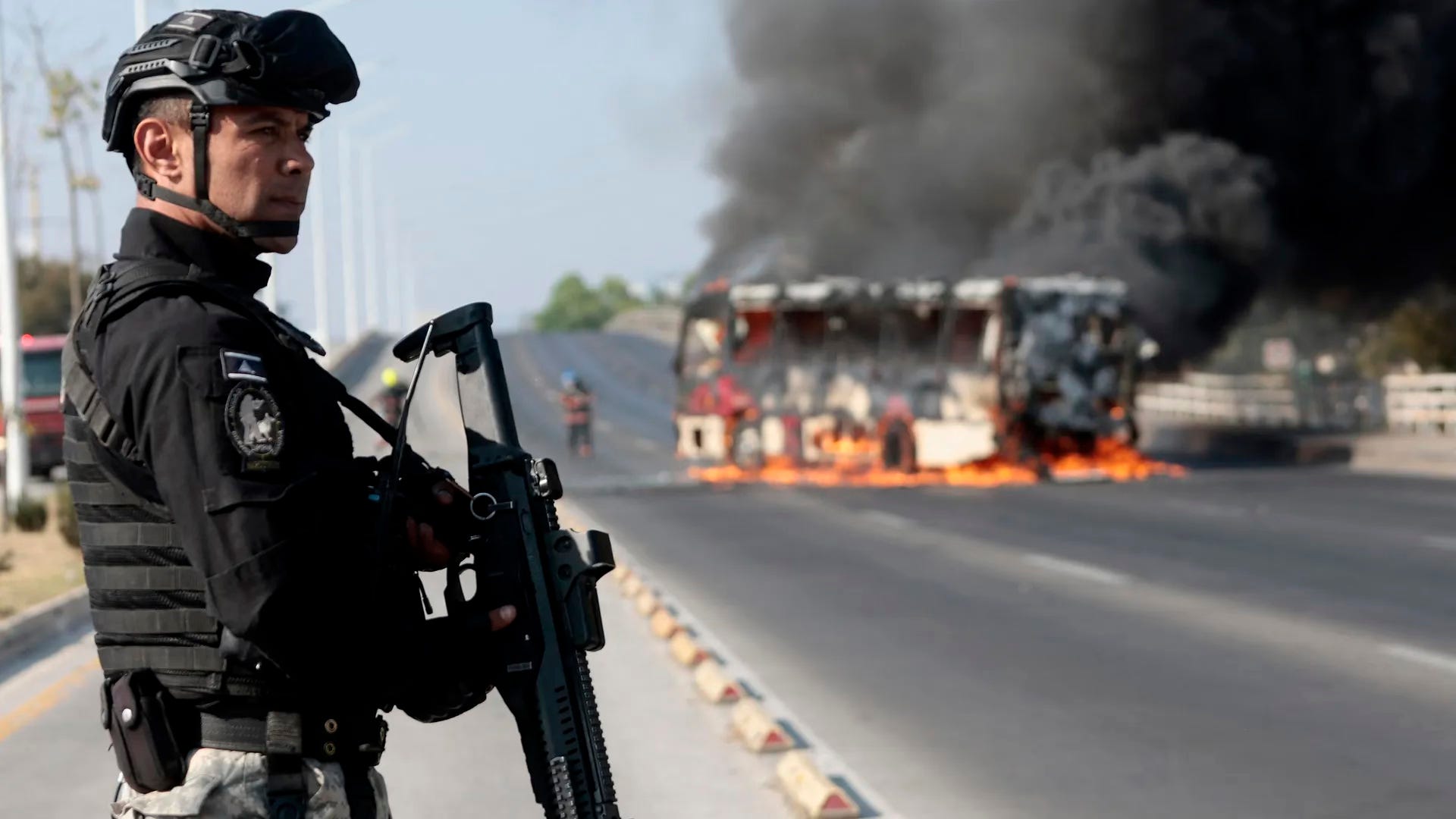
It was all so wretchedly typical.
The death toll in Mexico’s war with drug cartels over the last 20 years alone is estimated to be 350,000 to 400,000. To put that in perspective, the United States suffered 58,000 dead in the Vietnam War.
But if tourists aren’t inconvenienced, Americans, Canadians, and the rest of the Western world pays no attention. And that is only the beginning of our callousness and hypocrisy.
All the horror and misery of the illicit drug trade is the product of policies conceived and enshrined in international law and international institutions by the United States. All the other developed countries either actively supported these American initiatives or at least went along with them. These policies have failed. Spectacularly. From production to retail, the global illicit drug trade is bigger than ever. And the price tag? A commonly used estimate puts the total global spending in support of prohibition at $100 billion. Each year. By one very rough estimate, the United States alone has spent more than $1 trillion on the war on drugs since the Nixon era. That’s “trillion” with a "T.”
But this approach is not merely a failure. It is also destructive. The criminal prohibition of drugs fosters bloodshed and corruption everywhere the illicit drug trade exists — which is everywhere — but the distribution of that bloodshed and corruption is wildly uneven. Yes, there’s some in consumer countries such as the United States, Canada, Britain, France, and Germany. But it is overwhelmingly concentrated in Mexico, Colombia, and other developing countries where illicit drugs are produced or shipped. The world’s attention is not similarly distributed. In fact, most of the developed world — very much including the United States — ignores the carnage except when there’s some new flareup. Or tourists are inconvenienced.
So today, I’m going to run through the history of drug prohibition with a particular focus on the countries most harmed — basically, the stuff foreign journalists always ignore in their brief and superficial coverage of the latest drama.
What I’m not going to do is carefully footnote sources and walk through the evidence supporting the claims I will make. This is such a huge story that doing that properly would take a book. I don’t have time to write that book. And more to the point, I already wrote that book decades ago, when I spent years travelling, researching, and writing about illicit drug policy for a Canadian newspaper. Back then, I published enough to fill a long book, maybe two. Lots of people noticed. I won awards. I had top drug officials tell me they thought I was right, that the whole war on drugs was futile and destructive and something had to change.
Nothing changed. And that’s the one thing you should take away from this essay. The names, dates, and details change over time. But the fundamentals never do.
I was actively researching and writing about drug policy between 1998 and 2010. Decades earlier, many smart observers had identified those fundamentals and documented them in detail. Their work changed nothing. My work was built on their work. My work changed nothing.
At this point, I expect nothing will ever change, no matter how much evidence and bitter experience pile up. There are too many entrenched institutional interests and established habits and practices. Also, it takes real effort to understand that the war on drugs has not only failed but it is actually the cause of far more damage then the drugs themselves — and is, in fact, the cause of much of the misery we blame on the drugs. And until the public has that understanding, promising to “crack down” and “get tough” will always be an easy political sale, while the fundamental reforms needed to do away with the war on drugs will always be political poison.
That is why I think nothing will change.
But if you’re interested in a story of how our governments have spent a full century and staggering amounts of money pursuing a policy that can never accomplish its goals, but is guaranteed to continue inflicting terrible harm, this is for you.
“A Drug-Free World — We Can Do It!”
I started in journalism in 1997.
The following year, the United Nations — acting at the behest of the United States, as usual — convened a General Assembly Special Session (UNGASS) to talk about the scourge of drugs. The UNGASS was a big deal at the time and it got a ton of coverage. That is what prompted me to start researching illicit drug policy.
Do you remember how the 1998 UNGASS concluded? Almost certainly not.
The conclusion was summed up in its official slogan: “A drug free world — we can do it!” Specifically, the nations of the world formally signed onto an agreement that the whole drug trade, from production to consumption, would be substantially curtailed, if not eliminated, by 2008.
Do I have to say that the world did not become drug-free in 2008? That drug production and smuggling grew by leaps and bounds over those years?
Do I have to say that the illicit drug trade is bigger and uglier today than ever? One small data point sums it up: The volume of cocaine produced in the world today is three times higher than the volume produced in 1998.
But the abject failure of the 1998 UNGASS made no difference whatsoever because, by the time the 2008 deadline rolled around, the illicit drug trade had long since vanished from the news. Which is how the responsible officials wanted it. They stayed mum. The deadline came and went unnoticed.
That’s how it always goes. Some major event — like a UN assembly or the killing of a cartel leader or a celebrity overdose — draws major attention to the issue, everyone gets upset, then we all drop the subject and forget what happened. Repeat, repeat, repeat for more than a century.
Let me underscore that last point: “for more than a century.”
American newspapers, including The New York Times, often state as fact that the war on drugs is either 40 years old or 60. That’s because they date the “war on drugs” either from Ronald Reagan or Richard Nixon. But that’s wrong. Reagan only expanded the war on drugs; he didn’t initiate it. Nixon only created the phrase “war on drugs,” not the policy.
So when did it really start? There is no clear line but international drug prohibition dates back at least to 1919 and the Treaty of Versailles that ended the First World War. That treaty required signatories to also sign onto a 1912 convention calling for the prohibition of drugs. (Or rather, certain drugs. Hypocrisy is an essential feature of the war on drugs.)
So how did that provision get into the seemingly unrelated Treaty of Versailles? Its inclusion was driven by a determined British diplomat who was an anti-drug crusader with the invaluable support of the American delegation. From that moment on, the United States became the prime mover of international drug prohibition — the country that chooses the policies and strong-arms others into adopting and enforcing them. The war on drugs is international but its headquarters has always been in Washington DC.
An illustration: Until Ronald Reagan, there was no such crime as “money laundering.” There were proceeds of crime, but moving money around for any reason wasn’t a crime in itself. But the Reagan administration, using an amazingly simplistic sort of Economics 101, concluded that if law enforcement could take the profit out of the illegal drug trade by finding and seizing the proceeds of crime, it could eliminate the trade. To do that, a huge new apparatus of laws and reporting requirements would be needed. So it created that. Then it took the policy international and used the UN and other mechanisms to push other countries to agree to do the same. They did. That is the origin of the vast, labyrinthine, national and international anti-money laundering system in place today.
Did it work? Ask yourself this: Is the illicit drug trade still profitable today?
It was one of the most spectacular failures in the history of public policy. And no one noticed.
The Origins of Mexico’s Cartels
Not coincidentally, around the same time that the American delegation was pushing drug prohibition in the Treaty of Versailles, the American alcohol-prohibition movement that had been making steady gains for many years scored it’s final victory: In 1919, the US constitution was amended to prohibit alcohol and the Volstead Act was passed to enforce it. Nation-wide Prohibition began January 17, 1920.
With that, the United States abolished the legal, supervised, regulated market for alcohol. Activists expected that would be the end of alcohol and all its evils. No more drinking. American would be healthier and happier. Children would play in the sunshine.
Yes, they really were that naive.
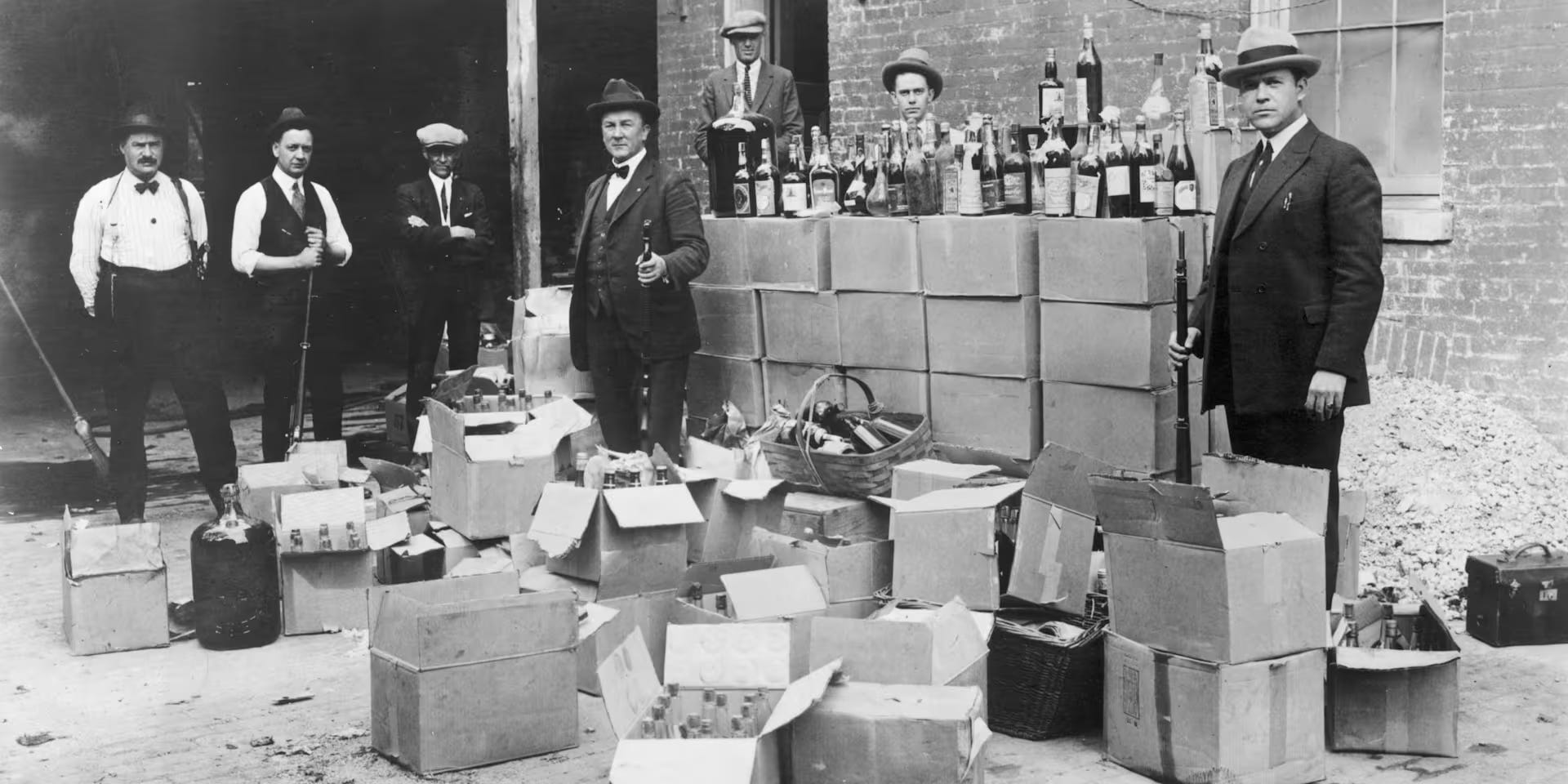
The demand for alcohol didn’t vanish so the market didn’t either. It simply became a black market. In a black market, producers and sellers risk arrest and prison so they demand a risk premium on top of normal profit. In simpler terms: When a drug is banned, its price soars. Soaring prices entice more producers, distributors, and sellers to enter the market. Demand creates supply. Always.
There are two ways to best illustrate the futility of fighting these economic forces.
The first is prisons.
High walls, barbed wire, guards, all entries and exits controlled and searched: If there’s one place on Earth where we should be able to keep drugs out, it is prisons. As it happens, I know a lot about prisons. In fact, I’ve been in a lot of prisons — thanks to years of research doing other research on criminal justice policies — including some of the biggest and scariest prisons in Russia, the United States, and Canada. But I have never been inside a drug-free prison. I don’t think such a thing exists. Because demand creates supply. Even inside prisons.
A more disturbing illustration is the Warsaw ghetto. The Nazis herded Jews inside then built walls, checkpoints, and guard towers. They controlled everything that went in or out with utter ruthlessness. The Nazis also ordered that food rations going into the ghetto would be capped at a level so low the whole Jewish population would soon starve to death. There was widespread starvation in the ghetto, and deaths, but the levels of starvation were far lower, and slower to develop, than you would predict using the official ration level. The explanation? Even in this hellish police state, the demand for food generated a large and sophisticated black market that smuggled enough food to make a significant difference, a form of resistance that only ended when the Nazis stormed the ghetto and sent survivors to the death camps.
Trying to stop supply from getting to demand can be like stopping the tides with brooms. It just doesn’t matter how many brooms you have.
So what does the criminal prohibition of drugs accomplish? Along with much higher prices, it reliably eliminated government supervision and regulation. It also replaces the ordinary, law-abiding, tax-paying citizens and corporations who are the producers and sellers of drugs in a legal market with criminals.
In the 1920s, Prohibition produced these changes in the United States. With devastating consequences.
One was that alcohol was increasingly riddled with contaminants and adulterants. A bad batch of booze could mean permanent blindness. Or paralysis, like the infamous “Jake leg.” Or death.
A second consequence a steep rise in the potency of alcohol. This is a key feature of illicit markets which few people understand.
Picture a large barrel of beer that is 4% alcohol. Now picture a case of whiskey that is 40% alcohol. They may contain the same overall amount of alcohol, but the whiskey’s higher potency means it is much smaller in volume. And if you’re a smuggler, smaller is always better because smaller is easier to smuggle. So you will always prefer smuggling 40% whiskey over 4% beer, just as you will prefer smuggling 80% rotgut over 40% whiskey. This is a central reason why 1920s Prohibition was the great era of the cocktail: It was much easier to get your hands on high-potency liquor than beer or wine, and that liquor often didn’t taste good because it was made by amateurs in bathtubs or God knows what. So people concocted recipes to make it palatable.
In this way, prohibition — whether of alcohol or any other drug — creates a dynamic that pushes black markets toward higher potency. And higher potency typically means a greater risk of overdose.
The effects of this dynamic can be seen everywhere.
Consider how hard is it to buy cocaine — powder or crack — in a big city. The answer is “not very.” It pretty much doesn’t matter where you live. There’s lots of it around. But what about coca leaf? Coca leaves are the source of refined cocaine. You can brew coca leaf in a tea, or infuse it in wine or soft drinks — yes, Coca Cola once did contain cocaine — or chew it, as indigenous peoples have done for thousands of years. Any of those deliver a mild dose of the same drug. So how hard is it to buy coca leaf where you live? Unless you live in Colombia or another producer nation, it’s essentially impossible. Coca leaf is extremely bulky compared to refined cocaine powder so organized crime smuggles cocaine, not coca.
As a result, the far more potent and dangerous form of the drug is everywhere while the milder, safer form is nowhere to be found. Thanks to the criminal prohibition of drugs.
The other big change from the shift to black markets is violence and corruption.
Drugs like cocaine are notorious for it. You can’t say the word “cocaine” without picturing gangsters with Uzis. Is that because these drugs have pharmacological properties that somehow foster gangsterism? Of course not. It has nothing to do with the drug. Cocaine, morphine, heroin, and the rest were all legal and sold widely until the 1920s, roughly, and in that era they were no more associated with gangsters than beer is today.
It’s the drug’s legal status that matters.
Ordinary businessmen conduct business lawfully, and they settle disputes with negotiation or lawsuits. None of that applies in a black market, or is even available, should a drug smuggler wish to sue rather than shoot. So traffickers settle disputes with bullets and bombs.
Nor can victims of crime working in a black market call the police, so traffickers — who often carry a lot of cash — are themselves preferred targets of criminals. And all these criminals, threatened by law enforcement, may protect themselves by resorting to violence or corruption or both. In Latin America, there is an old expression: “plata o plomo?” It means “silver or lead?” It’s the choice offered to policemen and judges and other officials: Be good to us and be rewarded — or die.
Also, it’s important to bear in mind that black markets tend to be ruthlessly Darwinian, so the more out-of-control a black market gets — more on law enforcement’s role in making that happen later — the more the market rewards ruthlessness. This dynamic means the criminals get more vicious. The violence gets more brutal. And the corruption spreads like cancer.
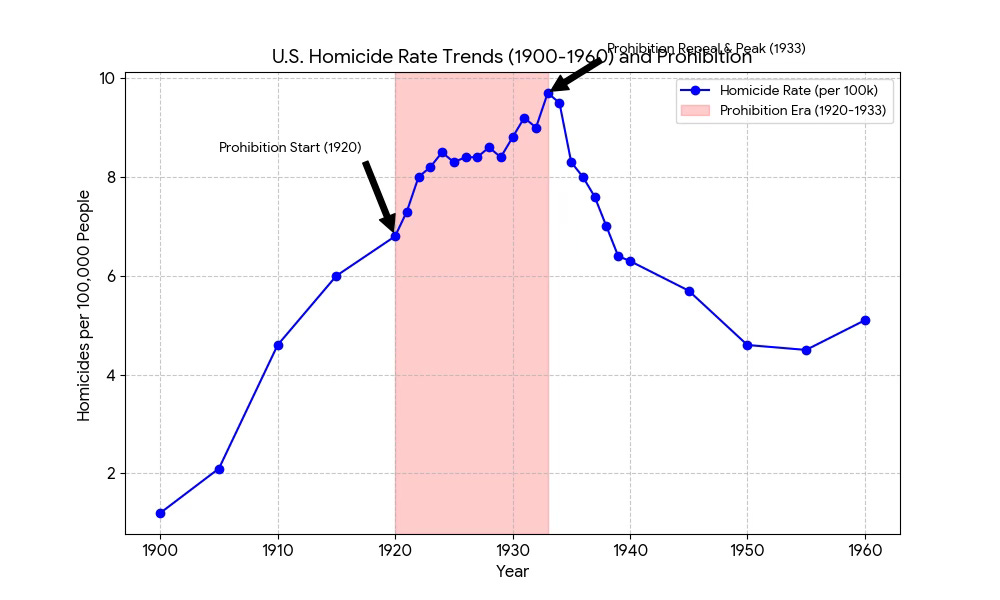
In the 1920s, Prohibition caused both violence and corruption to explode across the United States. One simple illustration is the following chart, which is the American homicide rate between 1900 and 1960.
The biggest crime drop in American history happened after 1933.
Why? It was the Great Depression before 1933 and the Great Depression after 1933. What changed in 1933?
Prohibition was repealed.
But these are all domestic consequences of prohibition, whether of the Prohibition of alcohol in the 1920s or the prohibition of other drugs today. There are also international consequences. And what Western countries consistently fail to appreciate — or at least, care about — is that the international consequences of prohibition can be, and have been for a very long time in Latin America, so much worse in countries where drugs are produced or trans-shipped.
You think we have drug-related problems? Our problems are minor compared to theirs.
In Mexico, it started in 1920 with Prohibition in the United States.
Just as lots of Canadians worked with Americans to ship alcohol south into the black market, so many Mexicans did the same to move alcohol north. Some came to form what is known as the “Gulf Cartel,” the first of its kind. It’s still in operation, in fractured form. Prohibition also turned border cities like Tijuana and Mexicali into magnets for Americans looking to buy what they couldn’t at home. That, too, is still true today.
The end of American Prohibition in 1933 hurt Mexican organized crime as much as it hurt American organized crime. During the Second World War, the US encouraged Mexico to grow opium poppies that could be turned into opium and refined into morphine for its soldiers. It became a major industry. When the war ended, the US declared it all illegal again, but it didn’t simply vanish. In the post-war years, heroin and marijuana still flowed north to satisfy American appetites. But demand in the US was relatively low so the amounts were what we would consider relatively low.
The groups smuggling the drugs also tended to be small, made up of extended family, and mostly non-violent. This worked because PRI, Mexico’s ruling party — Mexico was not a real democracy in these years — effectively licensed the smugglers. Families would be given the right to smuggle certain amounts from certain regions and they had to abide by certain rules. Those that overstepped, perhaps by engaging in other criminality or violence, were quickly and ruthlessly slapped down. The result was a drug trade that operated quietly for decades.
That started changing in the late 1970s. As usual, the cause was the United States.
American drug use soared in the 1970s and in the disco era Americans rediscovered cocaine. It was suddenly chic, as this 1981 Time magazine cover demonstrated.
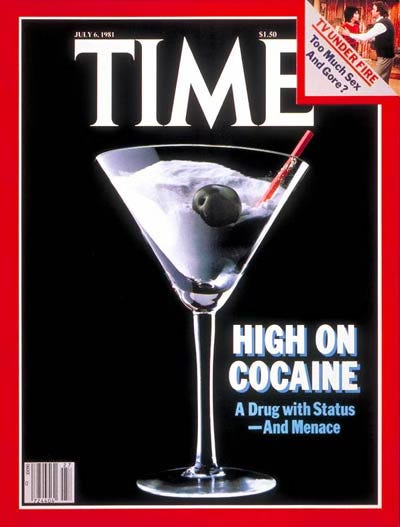
As a result, the small-time smuggling of minor quantities of cocaine produced mostly in Bolivia shifted into Colombia, where it exploded. Two new trafficking networks emerged, the Cali and Medellin cartels, the latter headed by the increasingly unhinged Pablo Escobar. Sending cocaine north to Miami, mostly by boat through the Caribbean, the cartels grew fantastically rich and powerful. Corruption festered, rotting away at Colombia’s police, judiciary, and government. Long-running Communist insurgencies in the jungles worsened.
At the direction of Ronald Reagan, the US cracked down hard, interdicting the drug boats and ramping up counter-cartel efforts. Colombia was wracked by brutal violence, even terrorism. Finally, in 1993, Pablo Escobar was killed, finishing the Medellin cartel. Then the Cali cartel was dismantled.
These were great victories in the war on drugs that garnered massive international attention. They were even turned into books, movies, and TV shows. But what all the books, movies, and TV shows left out is that these victories accomplished nothing. Less than nothing, in fact.
After the foreign reporters went home, left-wing insurgents, right-wing paramilitaries, and new gangsters took over from the dead or imprisoned gangsters. The only lasting effect of smashing the original cartels was to decentralize the narco business, so instead of two big operators there were many. The struggle for market share became more intense, and in important ways the situation actually got worse.
In the late 1990s, as part of the same effort that created the 1998 UNGASS, Bill Clinton announced “Plan Colombia” — a big push to strengthen the Colombian government against the paramilitaries and insurgents and wipe out the farming of coca bush, the source of cocaine, along with the jungle labs where cocaine is produced from the leaves.
I went to Washington in that era. Officials were serenely confident that they would wipe out the Colombia drug trade. I also went to Colombia in that era. It was surreally dangerous. Picture an ice cream parlour with a uniformed guard carrying a machine gun. That was Bogota.
I once sat for an interview with an advisor to the president of Colombia. A reporter from the Los Angeles Times sat beside me and she dutifully asked all the standard questions about Plan Colombia. The advisor dutifully delivered all the standard answers, looking to me like a man who was saying only what the gringos in Washington wanted to hear, not what he believed.
So I asked him about Prohibition in America. “If it didn’t work then, in the United States,” I asked him, “why would it work now, in Colombia?”
His eyes lit up. He started talking a mile a minute, going on and on about Al Capone, never quite saying “this is all futile and destructive” but nudging up close to it while leaning forward and all but begging me to say it.
That was the first time I encountered something I later realized is common as coca in Latin America: The smarter politicians know the war on drugs is futile and destructive but they will not say so. They cannot say so. They are elites. The capital city of Latin American elites is Miami. If the US government were to refuse them a visa, their careers would be ruined, and the US government does indeed refuse visas to those who step too far out of line on drugs. So Latin American politicians overwhelmingly repeat the words the US wants them to speak and never say what they really feel. Until they retire. Lots of top-tier Latin American politicians have denounced the war on drugs as stupidity on stilts. But only when they’re old and grey.
If you’ve watched the television series Narcos, you know some of this history. But what Narcos did not underscore is how important it was that the US started interdicting drugs boats in the Caribbean in the 1980s.
Drug production and drug smuggling is often likened to a balloon: Squeeze it in one place and it bulges in another. That’s exactly what happened in the 1980s as the US focussed on the Caribbean and Colombia.
With the route to Florida under pressure, the Colombian cartels developed Mexican contacts in order to set up smuggling pipelines through Mexico to the United States.
In Mexico, meanwhile, a former police officer named Miguel Ángel Félix Gallardo knit together many of the small smuggling operations into what became known as the Guadalajara Cartel. Félix not only helped the Colombians smuggle into America, he cut deals to be paid in cocaine, which his own organization smuggled north. As the Colombians grew increasingly desperate at home, Félix demanded as much as one-half of each shipment. The Guadalajara Cartel grew immensely rich and power shifted from Colombia to Mexico.
In a very real sense, American demand for drugs and American drug policy combined to create the Mexican cartels. I’ll say that again because this is the key fact which Americans almost universally ignore: The Mexican cartels were created by American demand for drugs and American drug policies.
In the early 1980s, Mexican gangsters still preferred to operate relatively quietly. That meant minimizing violence. But in 1985, they murdered a US DEA agent, the US government leaned hard on Mexico to get tough, and it did. What followed was a classic spiral of tougher law enforcement escalating violence, leading to tougher enforcement and escalating violence.
This illustrates something that is well known among those who study organized crime: The worst typically does not occur when only a few mature, established crime groups are in place, for the simple reason that when you’re the gangster who is running the show and profiting handsomely, you do not want to upset the status quo by drawing attention and provoking crackdowns. As a result, organized crime in a dominant position often clamps down on others who would disturb the peace. In effect, they act as a strange sort of law enforcement. It is when such controlling networks are disrupted — such as by law enforcement taking out top gangsters — that all hell breaks loose.
Mexico is painfully familiar with this cycle. In 2006, Mexican President Felipe Calderón launched a full-scale, militarized attack on the cartel kingpins. It worked brilliantly. One after another, the kingpins were killed or sent to prison and the cartels fractured. These were smashing victories in the war on drugs.
But as in Colombia a decade earlier, these victories accomplished less than nothing. Underlings took control of the fractured remnants of the cartels and the flow of drugs continued, while the struggle for market share spread.
Off and on, Mexico has been doing this ever since. The killing of “El Mencho” and the cartel violence that followed is just the latest skirmish in a never-ending war.
So, aside from as many as 400,000 dead, what does Mexico have to show for all this? Pretty much everything is worse. More drugs. More trafficking. More violence and corruption. But one thing has definitely changed: Fighting and dying in a Darwinian hell, Mexico’s cartels evolved, and they are now far more twisted and dangerous than they were 40 years ago. Or even 20 years ago.
Murder was once a last resort; now it’s just another day at the office. Gangsters used to go after gangsters only; now family members and ordinary citizens are all in play. Violence used to be instrumental only; now there is a sick underworld culture that celebrates ever-more baroque forms of torture and slaughter, with victims’ bodies left on public display.
A horrific illustration: Prior to 2006, beheadings were almost unheard of in Mexico, but in response to the government’s escalation that year, gangsters beheaded two police officers. Later the same year, gangsters went into a disco and dumped five heads on the dance floor. In the years after, a gang called Los Zetas — which was started by Mexican special forces soldiers who switched sides — made beheading its signature.
And please remember, most of the ordinary cartel foot soldiers doing the fighting and dying are not rich, violent, psychopaths. Typically, they are extremely poor young men who join gangs mostly because they have no other prospects in life. It may be necessary to fight and kill them, but piling up their bodies is no cause for celebration. Think of how many Mexican mothers and fathers have lost their children this way.
It is all unspeakably futile, and Mexican officials aren’t stupid. They know that what they are doing is fuelling a destructive spiral. They know more killing will only accelerate the carnage, and can never stop it.
But Washington doesn’t give a damn.
Just listen to Republicans, including Donald Trump. They know little about Mexican suffering and care less. They only see the American perspective. And in the American perspective, the cartels are no different than an enemy army. Wipe them out and that is that. If you think this way, the continued flow of drugs into the United States is conclusive proof Mexico isn’t serious about fighting and beating the cartels — which makes the United States the aggrieved party. That the cartels mostly get the weaponry they use to kill Mexicans from the United States is almost never mentioned. Neither is the role of American demand or American policies in Mexican organized crime. No, in this perspective, the United States is blameless. It’s all the fault of Mexico.
As a result, Republicans have even been calling for the US to conduct military strikes in Mexico against the cartels, whether Mexico agrees to them or not. Apparently having learned nothing from the past century, they sincerely believe that if enough bad guys die the problem ends. That thinking — plus contempt for rule of law and a total collapse of moral judgement — also explains why the US is now firing missiles at boats suspected of smuggling cocaine. Legal observers are essentially unanimous that there is no lawful authority for these attacks, which makes them extrajudicial executions — the polite way of saying “murders.” More than 140 people have been killed so far. This campaign of serial murder will undermine the rule of law and disgrace the US military but, it is safe to say, it will otherwise accomplish nothing.
This is the neighbour Mexico has to deal with. There’s a reason why an old nugget of wisdom in Mexico goes, “poor Mexico, so far from God and so close to the United States.”
Mexico is a country that has been repeatedly invaded and bullied by the US, so no Mexican government can possibly authorize the US military to operate in Mexico. But no Mexican government can afford to tell the Americans to pound sand. That leaves only one option, which is what we saw in the killing of El Mencho. Of course I cannot read Mexican President Claudia Sheinbaum’s mind, but, given the history, and given that Sheinbaum had previously rejected the hardline approach, I think it’s a safe bet the attack on El Mencho was Mexico doing what the United States demanded not because the government believes it will do some good but because it has no other choice.
All of this is why it is so galling to see American reporters — and Canadian reporters, and reporters from other Western countries — show such care and concern for stranded tourists. When that story wrapped up, they all left the country as ignorant of what is happening, and why, as when they arrived.
But Mexicans can’t leave. It’s their country. And it suffers as a result of the appetites and policies of the same country that wags its finger at them and demands they “do something” — and never shows the slightest concern for Mexico’s horrific losses.
But again, I don't want to make this only about the United States. All Western governments have signed up to these futile and destructive policies. And their citizens, too, don’t care what those policies are doing to Latin America. That’s something I learned publishing all that work with a Canadian newspaper. When I wrote about drug policy and law enforcement as it related to Canadian cities, there was great response; when I wrote about what the same policies and institutions were doing to Latin America, which is so much worse, there was silence.
Staggering numbers of people have died in pursuit of a policy whose failure is abject and indisputable.
How can we ignore this when our own governments are implicated?
And yet we do.
The Scourge of Fentanyl
You may have noticed that I haven’t mentioned fentanyl in this whole essay. That’s what the big concern in North America these days, particularly the United States. Americans think fentanyl is so dangerous it justifies just about anything, even murdering suspected cocaine smugglers at sea. (No, that doesn’t make sense. But every time I denounce the Trump administration’s attacks on social media, I catch hell from Trump supporters angrily shouting about fentanyl. Yes, that’s really the level of debate.)
So how does fentanyl fit in all this?
Unlike cocaine and heroin, which are derived from plants, fentanyl is a synthetic drug produced in labs using precursor chemicals. Back in 1998, when the UN convened the UNGASS, illicit synthetic drugs were only just beginning to be a major problem, but they were proliferating. So the UNGASS resolution included a whole long section about clamping down on the development and distribution of synthetic drugs. That worked as well as all the other plans made in the year of “a drug-free world — we can do it!”
Fentanyl was first synthesized in 1960 for use in surgery, where it has done, and continues to do, important work. It is an opioid, meaning it is synthetic but chemically similar to the drugs derived from opium poppies — opium, morphine, and heroin. But it is massively more potent than those drugs. And that’s the key to explaining why it’s so dangerous.
The granddaddy of this family of drugs is opium. Before prohibition, it was legal and widely available. You could buy it at the pharmacy. Recreational users typically drank it as “laudanum,” a mixture of opium dissolved in alcohol, or they smoked it with a pipe.
Morphine is refined opium. It is around ten times more potent than opium.
Heroin is 20 to 50 times more potent than opium.
And fentanyl is 500 to 1000 times more potent than opium.
Now, remember what I said about potency and smuggling? For smugglers, more potent is always preferable because more potent is smaller. And smaller is easier to smuggle.
Fentanyl is a smuggler’s dream. A dose of fentanyl big enough to kill a single person is no bigger than the tip of a sharpened pencil, so even a big shipment of fentanyl is tiny relative to heroin, morphine, and opium.
Which is why, today, you can buy fentanyl pretty much everywhere. It’s so common and cheap it’s often mixed into other drugs to give them kick.
But opium? Say you wanted to consume opium as laudanum, or smoke opium. How hard would it be to buy some in a North American city?
It’s not hard. It’s impossible. As with coca leaves, criminals do not smuggle it.
You see what’s happened? The mildest and safest form of the drug is nowhere to be found. The most potent and dangerous form of the drug is everywhere.
That’s prohibition doing what prohibition does: Thank the war on drugs for the fentanyl scourge.
There was a time when I thought laying out these arguments would change minds and, eventually, laws. I no longer do. That’s why I stopped writing about drug policy many years ago. It’s too frustrating, too sad. This is all monstrously stupid, but I’m afraid it will never change.
So I thought I would write this up one last time in order to have it on hand here. In future, when the latest burst of soon-to-be-forgotten news about drugs is making headlines, and ignorant politicians call for more futility and destruction, I can just post a link to this essay.
And I will write: Plus ça change, plus c'est la même chose.
On this subject at least, it seems humanity will never learn from history.
Another superb piece.
When I did my Master's thesis, I looked at Canada's early drug policy. It was interesting to find the Canadian government lobbying the League of Nations for tougher international anti-drug treaties and enforcement through Interpol. Canada was in lockstep with the Americans, who used the League even though they were not members. People we think of as icons on the Left -- the political definitions have evolved-- people like Emily Murphy, whose book "The Black Candle" can be accurately described as racist hate lterature, also pushed this. All of our original drug laws were directed at minorities and at addicted war veterans.
How strange that I have lived through 50 years of The Hundred Years’ War and never realized it. Thank you for educating me. Although it is futile, I wish the Americans responsible for creating this chaos would listen. I applaud your ability to bring so much of this history alive in plain language.