
"We don't need anybody."
Words to carve on America's tombstone. And make the ghost of William McKinley moan.

It’s always dodgy to draw out a trend line of weeks or months — or years — many decades into the future, but if the current trend line of American decline does maintain itself into the second half of the 21st century, and the era of global American hegemony is consigned to history, alongside the British Empire and the Rome of Augustus Caesar, I have a suggestion for its epitaph: “We don’t need anybody.”
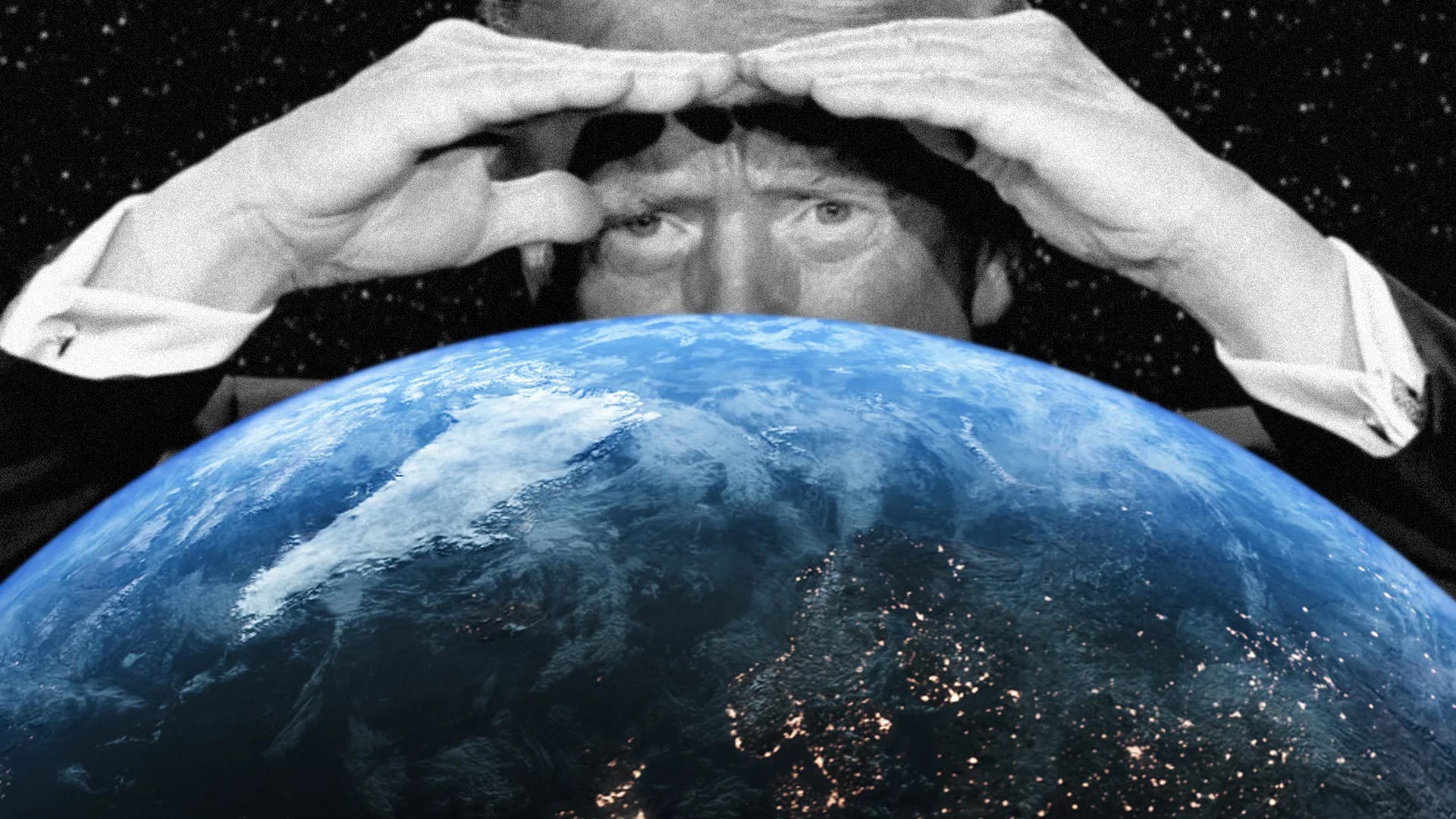
President Donald Trump spoke those potentially immortal words on Monday, as he was angrily attacking the allies who declined his kind offer to clean up the dangerous mess his impulsiveness has made in the Middle East.
Or perhaps I should write “allies.”
Trump has threatened one of those allies with war if it didn’t hand over land. He has threatened another with economic devastation if it don’t hand over its sovereignty. He has hammered all the allies with tariffs and demanding concessions — the polite term for this approach is “shakedown” — to avoid worse. He has suggested the United States may or may not support allies if they were attacked by Russia and he has nakedly betrayed Ukraine to Russia while those same allies make enormous sacrifices to support Ukraine. His officials have publicly promoted far-right extremists and separatists and his official policy is to destroy the European Union that most of America’s allies either belong to or support. All the while, he and his officials have insulted and disparaged and belittled his allies while dismissing their contributions and sacrifices — even the lives of their soldiers.
To top it all off, Trump insisted on Monday that America would be there for allies of the United States should they be threatened but he has known “for a long time” that his allies are freeloaders who would never be there for America if the United States. If there was a comment better calculated to offend and enrage allies who remember how — only a few months ago — the same man belittled what those same allies had done for the United States in Afghanistan, I cannot imagine what it is. Nor can I imagine I what allied soldiers who remember their dead comrades must feel. “Outrage” is surely understatement.
So “we don’t need anybody” wasn’t merely observation. It was another long stride toward the day when America, whatever its needs, has nobody.
“We don’t need anybody” is also a good summary of a basic operating principle of Trump and MAGA.
For Trump and Company, it is a bedrock belief that American might is so awesome that the United States can roam about the global schoolyard punching the other kids and stealing their lunch money without the slightest worry that this behaviour will ever have consequences. To say this is stupid is, again, understatement. People organized at any level — from schoolchildren to countries — do not simply allow themselves to be bullied forever. They seek to ally themselves with other powers. Or they band together to create their own power. If the bully is big enough, they may fail to teach the bully his folly, for a time. But eventually, they put the bully in a box. History is littered with examples.
“Fucking moron” is the term Rex Tillerson, Trump’s first Secretary of State, reportedly used in 2017 to describe the president. The White House denied it. Tillerson pointedly did not. I’m pretty sure he said it. And I’m as certain as I am about anything that he was right.
That’s no small claim. “Fucking moron” is a high bar for a head of state to leap over. The merely stupid cannot do it. Nor can idiots. It requires a sort of world-historic dumbfuckery, with grave consequences. In the case of the world’s only superpower, that means consequences so enormous they alter the course of civilization.
I believe Donald Trump is — like a pole-vaulter in a high-jump competition — clearing that bar with yards to spare. “We don’t need anybody” is the crowning illustration.
I wrote a long history of traditional American isolationism a couple of years ago. “We don’t need anybody” was effectively the maxim of that tradition. But I don’t say that to disparage isolationism.
Isolationism made good sense for America from Washington to Lincoln for the simple reason that America was a large, prosperous, and powerful country in a hemisphere wedged between two oceans that separated it from all the other large, prosperous, and powerful countries. The United States really did not “need anybody.” The oceans made all the difference, which is why pointing to the oceans as the guarantors of American security has always been the standard trope of American isolationism.
But in the late 19th century, technology started to change the world in profound ways.
Steam power and the telegraph knit the world together in what would later be called globalization, while, over the same years, the United States rapidly industrialized. American manufacturing became the world’s most efficient and productive and the American economy became the world’s largest. American technology raced ahead.
In this new world, interconnection and global trade were entirely in America’s interests. Not coincidentally, this was the first era in which American foreign policy started taking an interest in matters overseas. The United States fought the Spanish-American war. And a series of overseas territories — from Hawaii to Guam and the Philippines — came under American control.
The face of that era was Republican President William McKinley, who had made his name as a supporter of tariffs to block foreign wares from American markets. But as president, McKinley increasingly backed free trade deals so American wares could sell around the world.
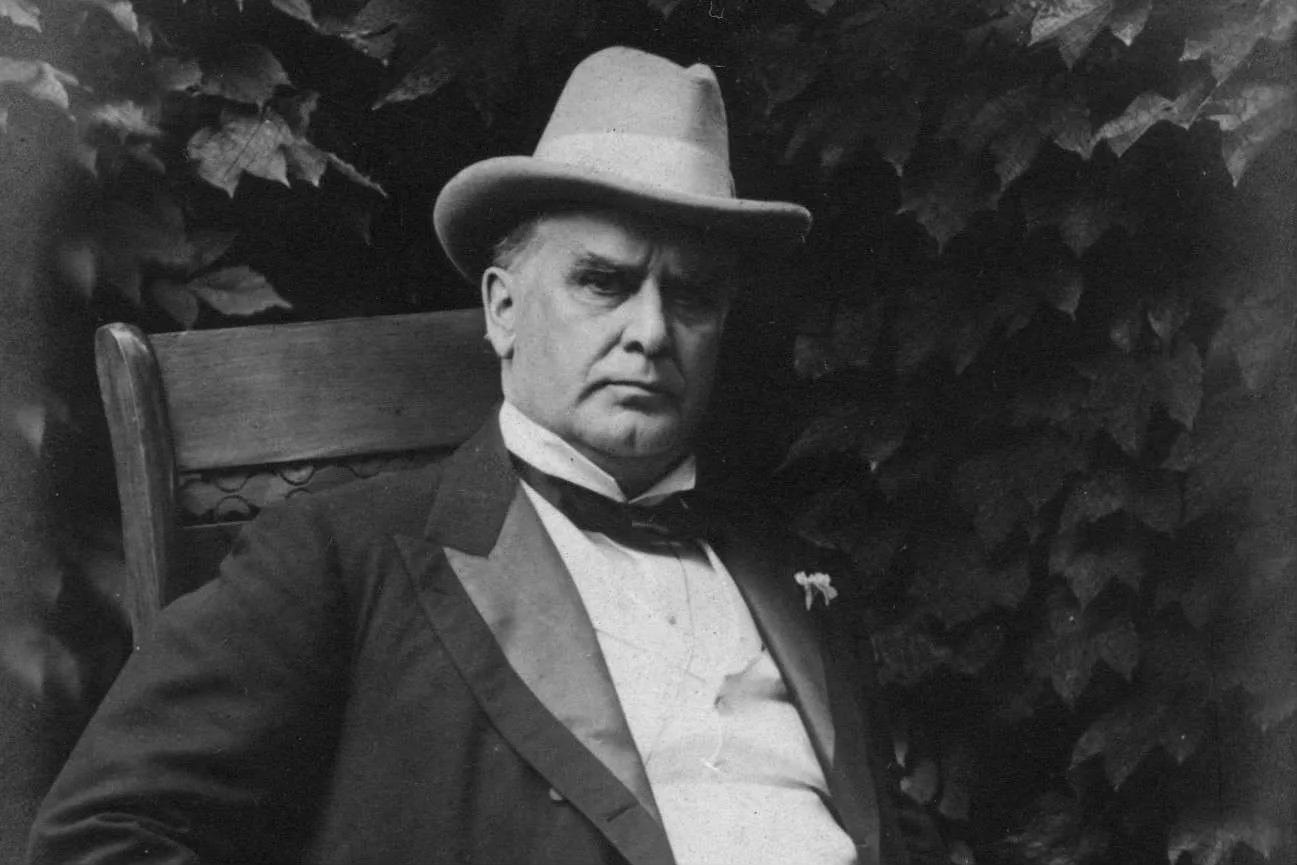
Some staffer must have informed Trump of McKinley’s existence because Trump has occasionally pointed to the McKinley’s advocacy of tariffs as proof of the wisdom of his own tariff policies. But Trump always leaves out McKinley’s growing support of free trade — which is a huge mistake because that’s the key to the whole puzzle.
McKinley was president when the 20th century dawned and had the wit to realize the world as Americans had always known it was changing profoundly.
In the final speech he ever gave as president — on September 5th, 1901, in Buffalo, New York — he explained.
…how near one to the other is every part of the world. Modern inventions have brought into close relation widely separated peoples and made them better acquainted. Geographic and political divisions will continue to exist, but distances have been effaced. Swift ships and swift trains are becoming cosmopolitan. They invade fields which a few years ago were impenetrable. The world’s products are exchanged as never before, and with increasing transportation facilities come increasing knowledge and larger trade. Prices are fixed with mathematical precision by supply and demand. The world’s selling prices are regulated by market and crop reports.
We travel greater distances in a shorter space of time and with more ease than was ever dreamed of by the fathers. Isolation is no longer possible or desirable. The same important news is read, though in different languages, the same day in all christendom. The telegraph keeps us advised of what is occurring everywhere, and the press foreshadows, with more or less accuracy, the plans and purposes of the nations.
McKinley was assassinated after delivering this speech. It should be better known.
The key sentence is in that passage: “Isolationism is no longer possible or desirable.”
The world was knit together, McKinley said. To use modern language, the world had become a global mesh of interlocking, interdependent systems. A reverberation far away would be felt everywhere. That meant “far away” was an illusion. There was no “far away.” Everything was interconnected. Everyone was interconnected.
That fact made it utterly foolish to ever say the words, “We don’t need anybody.”
William McKinley understood that in 1901, but a century and a quarter later, the world is orders of magnitude more intertwined. I’m writing this in an Australian hotel room. When I hit a button, it will instantly appear on screens all over the world. That’s a level of interconnectedness that would have made William McKinley faint.
Yet in 2026, incredibly, Donald Trump doesn’t get it. The man even talks about the “beautiful oceans” that isolate America from the world. And he says, “we don’t need anybody.”
This belief — outdated a century ago! — underpins his firm conviction that he can wander around the global schoolyard punching out the other kids and taking their lunch money and there will never, ever be consequences. And it is that behaviour that threatens to collapse the American empire faster than any barbarian invasion suffered by Rome.
This more than justifies Rex Tillerson’s judgement.
Donald Trump is a fucking moron. Carve it on the tombstone of the American empire.
Or if that’s a little too crude for the tastes of future generations, I suggest: “We don’t need anybody.”
“We don’t need anybody,” may not be true at the moment. But it is useful to consider that in the view of his followers, it is aspirational. It also references a prominent, enduring theme in American culture.
My brief moment of irony this mornings about interconnectedness. Normally I read your work in Ottawa which, I suspect, is often produced in Ottawa. So today you were writing in Australia and I am reading it over my breakfast in a Canberra cafe. Of course, both the ease with which I got here, and the ease with which I could have read it at home half a world away, demonstrate the premise.