
Liberal Democracy Needs A Story
Those who would destroy freedom know the power of a story drawn from history. Those who would defend it need to learn.

China staged a massive military parade to celebrate the 80th anniversary of Japan’s surrender in the Second World War.
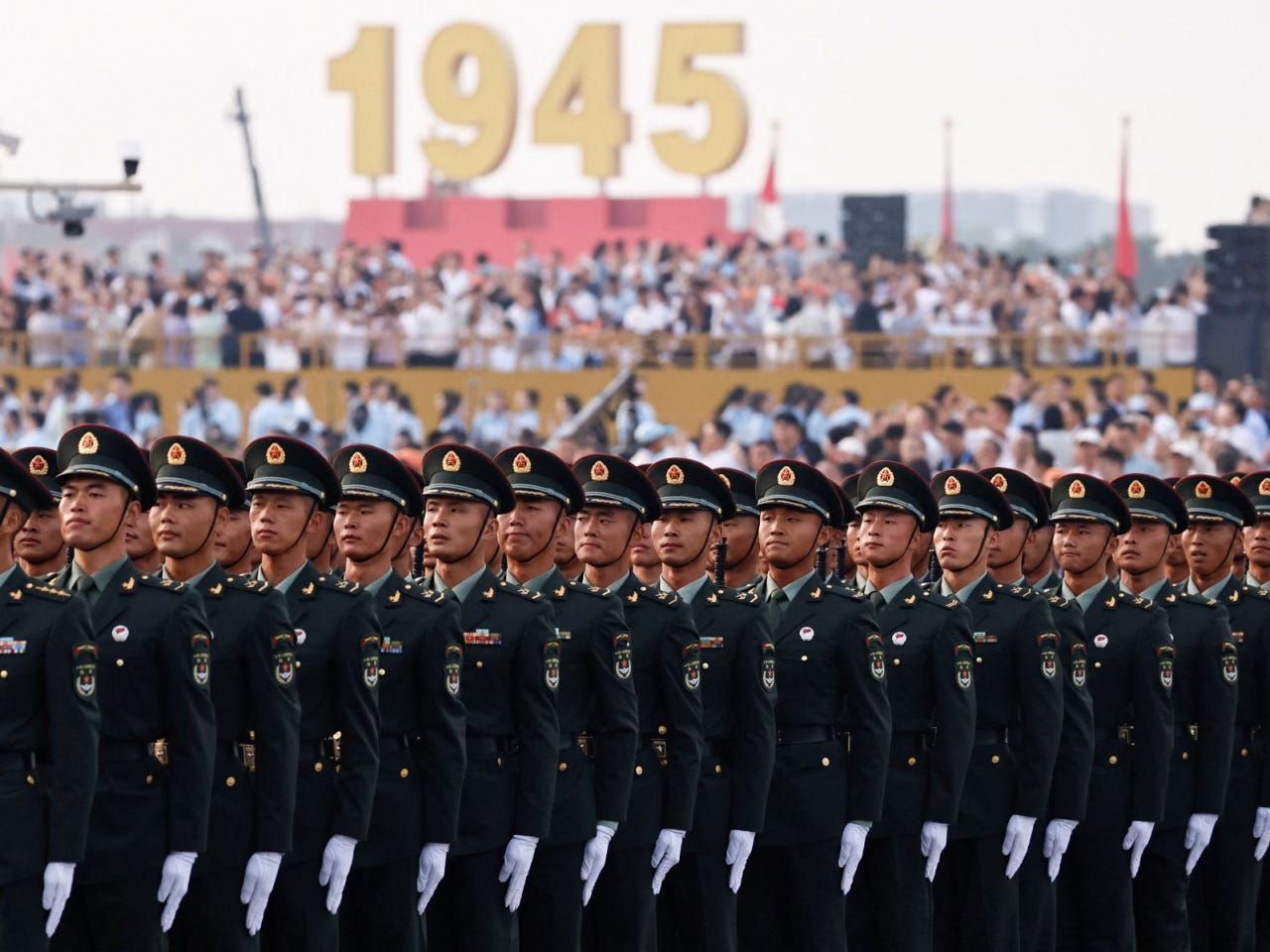
The day before, meeting in Beijing, the dictators of Russia and China used the anniversary to promote a version of the history of the Second World War useful to their grandest political ambition, the creation of an alternative to the international order long dominated by the United States. Xi Jinping called Russia and China the “main victors” of the war, and said these victors now seek a “more just and equitable” international order. Vladimir Putin repeated this claim of historical solidarity. “We were together then, we remain together now,” he said. Both countries will “defend historical truth and justice.”
As usual with dictators, a lot of what they said is lies.
On September 2, 1945, when Japan accepted defeat, it did so by signing surrender documents on the deck of the USS Missouri, an American battleship, which is a strong hint as to the identity of the “main victor” in the war against Japan. But that is the least of the dishonesty on display in Beijing.
A quick recap of some basic facts: In August, 1939, Nazi Germany signed a pact with the Soviet Union that effectively created an alliance and a division of spoils in Eastern Europe.
In September, 1939, Germany invaded Poland. Britain and France responded by declaring war. After Germany defeated the Polish army, the Soviet Union took the eastern half of Poland, as agreed with Germany. The Soviets proceeded to murder 22,000 Polish officers and intellectuals and deport between 700,000 and 1.5 million Polish civilians to Russia.
The Soviets later attacked Finland and stole some of its land. Then they seized Estonia, Latvia, and Lithuania, with Nazi support.
When Nazi Germany steamrolled Western Europe, and looked on the verge of invading Britain, the Soviets sat back and smiled.
This is why, in Russia today, the “Great Patriotic War,” as the Russians call the Second World War, dates not from 1939 but 1941 — which is when Nazi Germany turned on its erstwhile ally and invaded the Soviet Union.
And remember, throughout this whole period, as well as years earlier, Japan was steadily tearing off chunks of China and inflicting horrific atrocities on Chinese populations, most notoriously the rape of Nanking. What did the Soviet Union do for China in this period? Nothing. China wasn’t a Russian ally. Until almost the very end of the war, the Soviets honoured their neutrality agreement with Japan, freeing Japanese forces for the assault on China.
Only on August 8, 1945 did the Soviet Union declare war on Japan. By then, the war in Europe had been over for three months. Hiroshima had been destroyed by an American atomic bomb two days earlier. Japan was a walking corpse, its collapse imminent and inevitable. And that is when Russia went to war with Japan, mostly to seize land, including Chinese land.
Saying that “[Russia and China] were together then, we remain together now” is one of the most disgusting lies ever uttered by a head of state.
The Chinese lies were almost as bad.
In the 1930s, as Japan escalated its attacks on China, the Chinese government was headed by Chiang Kai-shek, the leader of the Nationalist Kuomintang. In the same years, the Communists under Mao fought a civil war to seize power from Chiang. In 1937, the Japanese launched a major assault on China, prompting Chiang and Mao to agree to a truce so they could focus on the Japanese. Mao’s Communists were much weaker so they mostly stayed in rural areas away from the Japanese, although they did conduct guerrilla warfare against the invaders. The main defence of China was left to Chiang and the Nationalists, who were armed by the United States. The battles the Nationalists fought with the Japanese were colossal and horrific. And unsupported by the Communists.
When the Second World War ended in China, the civil war resumed. The Communists took power in 1949. Modern China, of course, is led by the Communist Party of China, the descendants of Mao, which makes the history of the war a little awkward for Xi and the CCP. So the Party has turned history on its head: In Beijing’s telling, Mao and the Communists were the principal leaders of China’s fight against the Japanese. Chiang and the Nationalists are mentioned but only as secondary actors, at best, and far from receiving credit for heroism and sacrifice, the Nationalists are vilified as corrupt and ineffectual. Unlike glorious Mao.
So the story told by Putin and Xi is a fraud, top to bottom, and Putin’s promise to “defend historical truth” a bitter joke.
But “dictator lies” is a “dog bites man” story. I wouldn’t bother if that’s all there was to this.
Instead, I want to underscore the contrast between the use of history by China and Russia with that of the liberal democracies they oppose.
China and Russia understand that history is, and always has been, an invaluable tool in the political struggles of the present and future. People are temporal creatures, after all. Ask them who they are and they won’t look at themselves as they are in this moment. They will look at what they felt, said, and did in the past — and use that to define themselves in the present and guide what they feel, say, and do in the future.
Dictatorships have always understood that.
In 1984, the ability of Big Brother to say, “we have always been at war with Eastasia,” and make the population really believe they have always been at war with Eastasia, is the regime’s greatest power. “Who controls the past controls the future,” goes the Party slogan. “Who controls the present controls the past.” So if China and Russia want to ally in the present to shape the international order in the future, China and Russia must have been friends and allies in the past — even if they have to turn twist history inside out to make that happen. “We were together then,” as Putin claimed, “we remain together now.”
So how is the US countering this story? It isn’t.
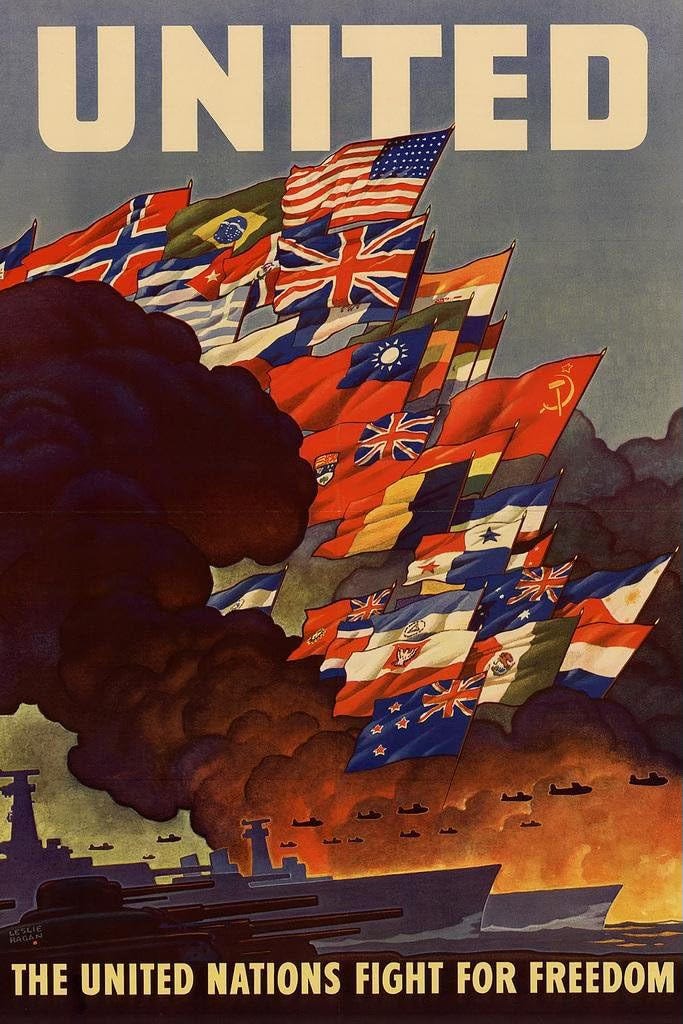
Donald Trump wants to watch the international order burn, for reasons that escape me. The US built that order. It led that order. It profited handsomely from that order. But given how many fires Trump has lit, we really have no choice but to conclude he wants a bonfire. It’s also clear that the selfish, vainglorious, chest-thumping president isn’t interested in telling any story about cooperation among the “United Nations,” as Americans routinely called the Allies during the war. So Trump’s little stab at international history this year was to dub VE-Day “US Victory Day,” because victory “was mostly accomplished because of us.”
But what about all the other liberal democracies that remain committed to the international order built on the rubble of the Second World War? What story about the past are Britain, France, Germany, Poland, Canada, Australia, and all the rest telling?
Mostly, they’re not.
This year not only marked the 80th anniversaries of the end of the Second World War in Europe and the Pacific. It also marked the 85th anniversaries of the German invasions of the Netherlands, Belgium, France, and most of the rest of Western Europe. That’s a lot of big anniversaries offering opportunities to seize the moment and draw together past, present, and future as Xi and Putin did. And this is a perilous moment for the international order. The principle that aggressive war is a crime that must be punished is close to being abandoned. The alliances that have been the foundation of the international order for the better part of a century are in danger. The will of free nations to remember and act on the lessons of the Second World War is in doubt. And under Donald Trump, the great guarantor of the international order has all but switched sides. At this perilous moment, with all that historical resonance in the air, what story about the past did the liberal democracies tell?
There were the usual commemorations for VE and VJ Day. With the usual words. And the usual participants. But it was all so pro forma, almost an old habit, something we do by rote, without feeling. There was nothing like what Putin and Xi did, no major effort to showcase a moment in which leaders extract meaning from the past, tie it to the present, and show how it can guide us to a better future. No story to inspire. Nothing that would make anyone leap to their feet and cheer, much less stand and fight.
But at least there were commemorations, however modest and routine. On the 85th anniversaries of Hitler’s invasions of Western Europe — the moment when the free nations of the world finally learned the brutal lesson that they must hang together or hang separately — there was mostly silence. As for the 85th anniversary of the Soviet occupations of Estonia, Latvia, and Lithuania, there was, as far as I can make out, nothing. That’s tragic. At this very moment, NATO soldiers are guarding the borders of Estonia, Latvia, and Lithuania against an ever-more belligerent Russia precisely because we learned our lesson the first time around. Why didn’t our leaders say so?
Incidentally, after the Soviet invasion of the Baltics, the United States issued the “Welles Declaration,” stating that the invasion was illegal so the United States would never formally recognize Soviet sovereignty over the lands it stole. This became a key principle of the post-war international order. When the Baltic countries regained their freedom in 1991, the United States didn’t welcome them as new nations. It welcomed them back. That seems like pretty relevant history right now, don’t you think? Shouldn’t liberal democracies that support the principle in the Welles Declaration — a principle that helped to reduce war for the better part of a century and is now in danger — make a big deal about it? Shouldn’t the NATO countries whose soldiers are stationed in the Baltics and looking through binoculars at Russian soldiers have made a concerted effort to tell this story?
But our leaders aren’t drawing on history to tell the story of who we are and what we stand for. So the free nations slowly drift this way and that, like sailors clinging to bits of wreckage after the ship sinks, while the Chinese and Russian battleships plough straight ahead.
A similar sort of drift can be seen within the United States, where a man every bit as venal and arrogant and destructive as Putin and Xi has pushed liberal democracy to the brink. A large majority of Americans opposes Trump’s authoritarianism, but that matters little when the MAGA forces are concentrated and determined while the opposition is scattered and leaderless.
One thing Donald Trump is indisputably good at is telling a story. True, his stories are as fraudulent as Putin’s. But they work. So what’s the opposition’s story?
American democracy has a quarter-millennium of history to draw on. What powerful stories are Trump’s opponents telling about that rich past, stories which explain why Trump is profoundly anti-American, stories that show America’s roots lie in liberal democracy and so, too, must its future? If anyone’s telling such stories, I haven’t heard. In The New York Times, Stephen Pinker — who’s been manning a metaphorical barricade at Harvard — noted that the Democratic Party should be drawing on resistance to Trump across the political spectrum, from the left to the centre-right, but it is “clueless, captured by its identity politicians and unable to formulate a coherent battle plan for winning elections or fighting in court.” Or telling stories that work.
This is the problem bedevilling liberal democrats the world over. Putin and Xi and Trump have their stories. So do Erdogan, Modi, Orban, and all the other reactionaries who have put freedom into headlong retreat. They are full of passionate intensity, to borrow from Yeats, while the best lack all conviction.
But history, as they say, repeats, or at least rhymes. And ours is not the first era in which liberal democracy seemed to be on a terminal decline.
Yeats wrote his famous line in 1920, after the First World War destroyed the international order that prevailed during the first period of globalization. By 1933, in the depths of the Great Depression, faith in liberal democracy had faded the world over. Liberal democracy seemed weak, disorganized, incapable of answering the terrible challenges of the day. Liberal democracy didn’t inspire. It was anemic. Dying. The future must either be fascist or communist. Or so many believed.
We came dangerously close to democracy’s end in those years. A mere tweak to the timeline here or there could have produced catastrophe. But eventually, the liberal democracies stood up and fought — and discovered that democracy may be fractious and messy but open societies are capable of delivering astonishing strength and determination, and beating even the most regimented dictatorships.
When the democracies went to war, they had no choice but to ask and answer the fundamental questions: Why? What do we believe in? What do we stand for? Why do we fight? By the end of the war, we knew the answers. The liberal democratic world — the free world — emerged from the war with a renewed sense of what it stood for and why it mattered.
That’s what we need now. We need to rediscover fundamentals, to see again what liberal democracy is and why it’s worth fighting for. We need our leaders to tell stories about how we got to this moment, where we should go, and how we can get there.
We need good stories. And good stories start with history.
George Marshall understood that when he was the US Army’s Chief of Staff. When the US finally entered the Second World War, Marshall was keen to produce a series of films explaining “why we fight.” And Marshall got lucky. The great Frank Capra enlisted as soon as the US entered the war and Marshall snatched him up. “Now, Capra,” he told the great Hollywood director, “I want to nail down with you a plan to make a series of documented, factual-information films—the first in our history—that will explain to our boys in the Army why we are fighting, and the principles for which we are fighting. ... You have an opportunity to contribute enormously to your country and the cause of freedom. Are you aware of that, sir?”
Capra was aware. The seven Why We Fight films remain landmark statements of what liberal democracy stands for, as well as what it will fight and die for. You can find them on Youtube. They’re still worth watching.
They will always be worth watching. Because, unlike the stories told by dictators, they are true.
Thank you for this. It is so necessary. Why is the West so weak and unable to stand up for itself? Because after the fall of the Berlin Wall and the collapse of the Soviet Union, it became complacent, comfortable and fat and took its eye off the ball. Because it was lured by the siren song of cheap Chinese labour into selling its manufacturing and industrial birthright to China which now dominates close to 50% of global manufacturing capacity, leaving the West unable to put together credible supply chains, and at China’s mercy for critical minerals. The US is no longer the arsenal of democracy and is in dire danger of being unable to wage war. On that score, because the rest of the West decided to act like spoilt children giving up on war, reaping a peace dividend, building out their welfare systems, based solely on American military protection, while claiming moral superiority over boorish America. Because the baby boomers aghast at the environmental degradation wrought by the post war economy used their demographic might to shut down western economies, blaming everything on nasty capitalism and corrupt elites, to the point where the West can’t build anything (see as exhibit California’s high speed rail project). Because, despite the best efforts of Pinker and others, Gramsci’s long march through the institutions has given rise to far left, so-called progressive movement that despises the West and all it stands for, wants to tear it down, and vilifies it as the embodiment of white supremacy, as racist, misogynistic and guilty of all the other heinous crimes in history, claiming that the US is an illegitimate colonial-settler country. Trump may not be helping, but he is not the one responsible for this abject state of affairs.
Isn't it ironic that we have the greatest (excuse the unintended parallel) story telling institutions in the world today in Hollywood? More resources, more talent, more experience to call upon than anywhere else. There are many great film making institutions in many countries that could jump on this bandwagon. They all have stories to tell to inspire and inform drawing on their own traditions and history. Must we wait until the apocalypse is upon us to fire up all this power to help the free world stand FOR something, not just against tyranny?